
“What was done to this vehicle last time?”
If the workshop has a complete vehicle service history, the answer may be available within seconds.
If the workshop relies on paper files, memory, WhatsApp conversations and scattered receipts, finding the answer can take much longer—or the information may be lost completely.
A vehicle service history provides a record of the work performed on a vehicle over time.
It can include:
Previous repairs
Maintenance services
Inspections
Diagnostic findings
Parts replaced
Labour performed
Estimates
Invoices
Payments
Mileage
Technician notes
Customer complaints
Recommendations
Future maintenance requirements
For a modern auto repair workshop, vehicle history is more than record keeping.
It can help technicians understand previous work, help workshop owners manage operations and give customers a better service experience.
This guide explains what vehicle service history is, what information a mechanic workshop should record, how to organize vehicle records and why digital vehicle history can be valuable for growing workshops.
What Is Vehicle Service History?Vehicle service history is a chronological record of the maintenance, inspection, diagnosis and repair work performed on a particular vehicle.
For example, a vehicle's history might contain:
January
Oil and filter replacement
General inspection
March
Brake inspection
Front brake pad replacement
June
Battery replacement
Electrical diagnosis
September
Suspension inspection
Shock absorber replacement
Instead of treating each visit as a separate event, the workshop can see the vehicle's history as one continuous record.
Why Is Vehicle History Important?Vehicles don't start from zero every time they enter a workshop.
A problem appearing today may be connected to work performed months earlier.
Previous records can provide useful context.
For example:
A customer says:
“The vehicle is making the same noise again.”
If the workshop can see that the same vehicle previously had suspension work, the technician has additional information to consider during the new inspection.
The history does not replace diagnosis.
But it gives the technician useful context.
What Should a Vehicle Service History Contain?A useful vehicle record should contain more than just the date of the last oil change.
Here are the most important categories.
1. Vehicle Identification
Record information such as:
Make
Model
Year
Registration number
VIN
Engine information where relevant
Current mileage
Vehicle colour where useful
Vehicle type
The registration number can help staff quickly identify a vehicle, while the VIN provides a more permanent identifier.
2. Customer InformationConnect the vehicle to the correct customer.
Record:
Customer name
Phone number
Email where applicable
Customer ID
Business/fleet information where applicable
This is particularly important for customers who own multiple vehicles.
3. Date of ServiceEvery service or repair should have a date.
This allows the workshop to understand how frequently a particular repair has occurred.
4. MileageMileage can provide important context.
For example:
January: 85,000 km
September: 92,000 km
This creates a useful timeline.
Mileage can also help the workshop identify maintenance patterns and make appropriate service recommendations.
5. Customer ComplaintRecord what the customer reported.
For example:
Customer reports that the engine takes longer than normal to start in the morning.
This is different from the technician's diagnosis.
The customer's original complaint should be preserved.
6. Inspection FindingsRecord what was discovered during inspection.
For example:
Battery terminals show corrosion. Battery voltage below expected level during testing.
This provides evidence supporting the recommended work.
7. DiagnosisRecord the diagnostic conclusion where one has been established.
For example:
Battery performance is below expected level and replacement is recommended.
Diagnostic information can become particularly valuable if the customer returns with a similar complaint.
8. Repairs PerformedRecord exactly what was done.
For example:
Replaced battery
Replaced brake pads
Repaired wiring
Replaced radiator hose
Performed wheel alignment
Avoid vague entries such as:
“Fixed car.”
Specific records are much more useful.
9. Parts UsedRecord relevant parts installed during the repair.
For example:
Brake pads
Oil filter
Air filter
Battery
Spark plugs
Belts
Sensors
Where appropriate, include:
Part number
Brand
Quantity
Warranty information
Record the relevant labour or service performed.
For example:
Front brake pad replacement and brake system inspection.
This helps explain what was done and how the final invoice was calculated.
11. TechnicianWhere relevant, record which technician performed or was assigned to the work.
This can help with:
Job accountability
Internal review
Technician performance
Follow-up questions
Rework investigation
Photos can provide valuable evidence.
For example:
Damaged component
Worn brake pad
Oil leak
Cracked belt
Damaged suspension component
Corroded electrical connection
Photos can also help customers understand why a repair was recommended.
13. Diagnostic ReportsIf diagnostic equipment was used, retain relevant results where appropriate.
This may include:
OBD scan results
Fault codes
Test results
Electrical measurements
Inspection reports
A diagnostic record can help provide context during future visits.
14. EstimatesKeep previous estimates associated with the vehicle.
This can show:
What repairs were recommended
What the customer approved
What was declined
What the estimated cost was
This is particularly useful when a recommended repair is postponed.
15. Job OrdersThe vehicle history should connect to the relevant job orders.
For example:
Vehicle ABC-123-XX
→ Job Order 001
→ Job Order 002
→ Job Order 003
This makes it easier to trace individual repair events.
16. Invoices and PaymentsThe service history can also connect to financial records.
For each repair, the workshop may be able to see:
Invoice
Total amount
Payment
Outstanding balance
Payment date
This creates a more complete picture of the customer's relationship with the workshop.
Why Paper Vehicle Records Become DifficultPaper records aren't inherently useless.
A small workshop can operate with paper files.
The problem appears when the volume of vehicles increases.
Imagine a workshop has several hundred customer vehicles.
A technician asks:
“When did we replace the suspension components on this vehicle?”
Staff now have to search through:
Paper job cards
Invoice books
Folders
WhatsApp messages
Technician notebooks
Customer receipts
The information may exist somewhere, but finding it takes time.
Digital Vehicle HistoryA digital vehicle record stores information electronically so authorized workshop staff can retrieve it more easily.
Instead of searching through physical files, staff can search for the vehicle.
The record can then show:
Vehicle
→ Customer
→ Previous inspections
→ Diagnoses
→ Repairs
→ Parts
→ Job orders
→ Estimates
→ Invoices
→ Payments
This is one of the major advantages of integrated workshop management software.
Vehicle History Helps TechniciansA technician should still inspect and diagnose a vehicle based on its current condition.
However, previous records can provide useful context.
For example:
Previous visit
Customer complained of intermittent starting problems.
Diagnosis
Battery voltage was low.
Repair
Battery replaced.
Current visit
Customer reports intermittent starting again.
The previous record gives the technician another piece of information to consider.
It may also help identify whether the same issue has returned or whether a different problem is now present.
Vehicle History Helps Workshop OwnersVehicle history isn't only useful for technicians.
Workshop owners can use records to understand:
Which vehicles return most frequently
Which repairs are common
Which parts are frequently replaced
Which customers return
Which services generate revenue
Which recommendations are repeatedly declined
Which vehicles have outstanding work
This can support operational decisions.
Vehicle History Helps Customer ServiceImagine a customer calls and says:
“My Toyota was serviced at your workshop some months ago. What oil did you use?”
If the workshop has a complete record, staff may be able to retrieve the previous service details.
Without records, staff may have to guess or ask the customer to provide an old receipt.
A good vehicle history allows the workshop to answer questions more confidently.
Vehicle History Helps Build Customer TrustCustomers want to know that their vehicle is being properly looked after.
A workshop that can show:
Previous repairs
Inspection results
Service dates
Parts replaced
Recommendations
can provide a more organized customer experience.
It demonstrates that the workshop is maintaining a record of the vehicle rather than treating every visit as an isolated transaction.
Track What the Customer DeclinedThis is an important but often overlooked part of vehicle history.
Suppose an inspection identifies three issues:
Brake pads require replacement
Battery is weak
Air filter should be replaced
The customer approves the brake pad replacement but declines the battery and air filter.
That information should be recorded.
At the next visit, the workshop can see:
Previously recommended:
Battery replacement — declined
Air filter replacement — declined
This prevents the technician from treating the issue as if it was discovered for the first time.
Track Recommended Future MaintenanceA vehicle history can also contain recommendations.
For example:
Brake fluid inspection recommended at next service.
or:
Front suspension components should be monitored.
This creates an opportunity for proactive customer communication.
The workshop can remind the customer when appropriate.
Service Reminders and Vehicle HistoryVehicle history becomes even more useful when combined with service reminders.
Suppose a customer had an oil service at:
10,000 km
and the workshop recommends another service at:
15,000 km
The system can help staff remember that the vehicle is due for another service.
Instead of waiting for the customer to remember, the workshop can send an appropriate reminder.
This can encourage repeat visits.
Vehicle History Can Support Customer RetentionGetting a customer once is useful.
Getting them to return for future maintenance and repairs can create a longer-term relationship.
Vehicle history supports this by giving the workshop a reason to stay connected with customers.
For example:
“Your vehicle may be due for its next scheduled service. Contact us if you'd like to book an inspection.”
This is more useful than sending random promotional messages.
Vehicle History for Fleet CustomersFleet operators may have many vehicles.
Keeping separate paper records for each vehicle can become difficult.
A digital vehicle history system can organize records by:
Vehicle
Registration
Fleet
Driver where relevant
Service date
Mileage
Repair
Cost
A fleet manager can then understand what has happened to each vehicle over time.
Vehicle History for Mobile MechanicsVehicle history can be particularly useful for mobile mechanics.
A mobile technician may service a vehicle at:
Customer's home
Office
Roadside location
Business premises
Fleet yard
If records are digital, the technician can update the vehicle history after the service instead of relying on handwritten notes.
This keeps the customer's record connected regardless of where the repair takes place.
Vehicle History for Pre-Purchase InspectionsVehicle records can also become useful when a workshop performs pre-purchase inspections.
The inspection creates a snapshot of the vehicle's current condition.
The workshop can record:
Inspection findings
Photos
Diagnostic results
Recommended repairs
Overall condition
If the vehicle later returns for repairs, the previous inspection can provide additional context.
Why Vehicle History Should Be Connected to Job CardsA vehicle history is much more useful when it connects directly to job records.
For example:
Vehicle ABC-123-XX
Job 001
Oil service
Job 002
Brake repair
Job 003
Suspension repair
Job 004
Electrical diagnosis
Instead of maintaining a single paragraph of notes, the workshop builds a structured timeline.
This makes the history easier to understand.
Why Vehicle History Should Be Connected to InventoryIf the workshop tracks parts inventory, the parts used on each repair can be associated with the job.
This allows staff to understand:
Which part was installed on this vehicle?
rather than simply:
Which part did we sell?
That distinction is important.
The workshop is not only tracking inventory.
It is tracking the relationship between:
Part → Repair → Vehicle → Customer
Why Vehicle History Should Be Connected to InvoicesSuppose a customer asks:
“How much did I spend repairing this vehicle last year?”
If invoices are connected to the vehicle record, staff can review the historical transactions.
They may be able to see:
Number of repair visits
Invoice amounts
Parts
Labour
Payments
Outstanding balances
This information can also help workshop owners understand customer value over time.
What Information Should You Avoid Losing?At minimum, every workshop should aim to preserve:
Vehicle identity
Make
Model
Registration
VIN
Mileage
Customer identity
Name
Contact details
Repair history
Date
Complaint
Inspection
Diagnosis
Repair
Parts
Labour
Financial history
Estimate
Invoice
Payment
Outstanding balance
Supporting evidence
Photos
Diagnostic information
Technician notes
Customer approvals
A simple structure can be:
Customer
Customer A
Vehicle 1
Toyota Example
ABC-123-XX
Vehicle 2
Honda Example
XYZ-456-XX
Each vehicle then contains its own timeline.
For example:
Vehicle 1
Inspection
Job Order
Estimate
Repair
Invoice
Payment
Service reminder
This structure is much easier to manage than mixing all vehicles belonging to one customer into a single file.
Vehicle History Checklist for WorkshopsFor every vehicle, ask:
Do we know the correct customer?
Is the registration recorded?
Is the VIN recorded where available?
Is mileage recorded?
Is the customer's complaint documented?
Are inspection findings recorded?
Is the diagnosis recorded?
Are repairs documented?
Are parts recorded?
Is labour recorded?
Are photos attached where useful?
Are diagnostic results saved where appropriate?
Is the estimate connected?
Is customer approval recorded?
Is the job order connected?
Is the invoice connected?
Are payments recorded?
Are outstanding balances visible?
Are future recommendations recorded?
Are service reminders tracked?
1. Recording Only the Invoice
An invoice tells you what was charged.
It doesn't necessarily tell you the complete diagnostic story.
Keep inspection and repair information too.
2. Recording Only the Customer
A customer may own multiple vehicles.
Always identify the specific vehicle.
3. Using Only the Registration Number
Registration numbers can be useful, but a more complete vehicle record should include other identifying information such as VIN where available.
4. Not Recording Mileage
Mileage provides useful context for maintenance and repair history.
5. Forgetting Declined Repairs
A recommendation that was declined today may become an important issue later.
Record it.
6. Not Attaching Photos
Photos can provide valuable evidence and context.
7. Keeping Records in Different Places
If customer information is in one file, job cards in another and payments somewhere else, staff have to piece the history together manually.
Integrated records are easier to manage.
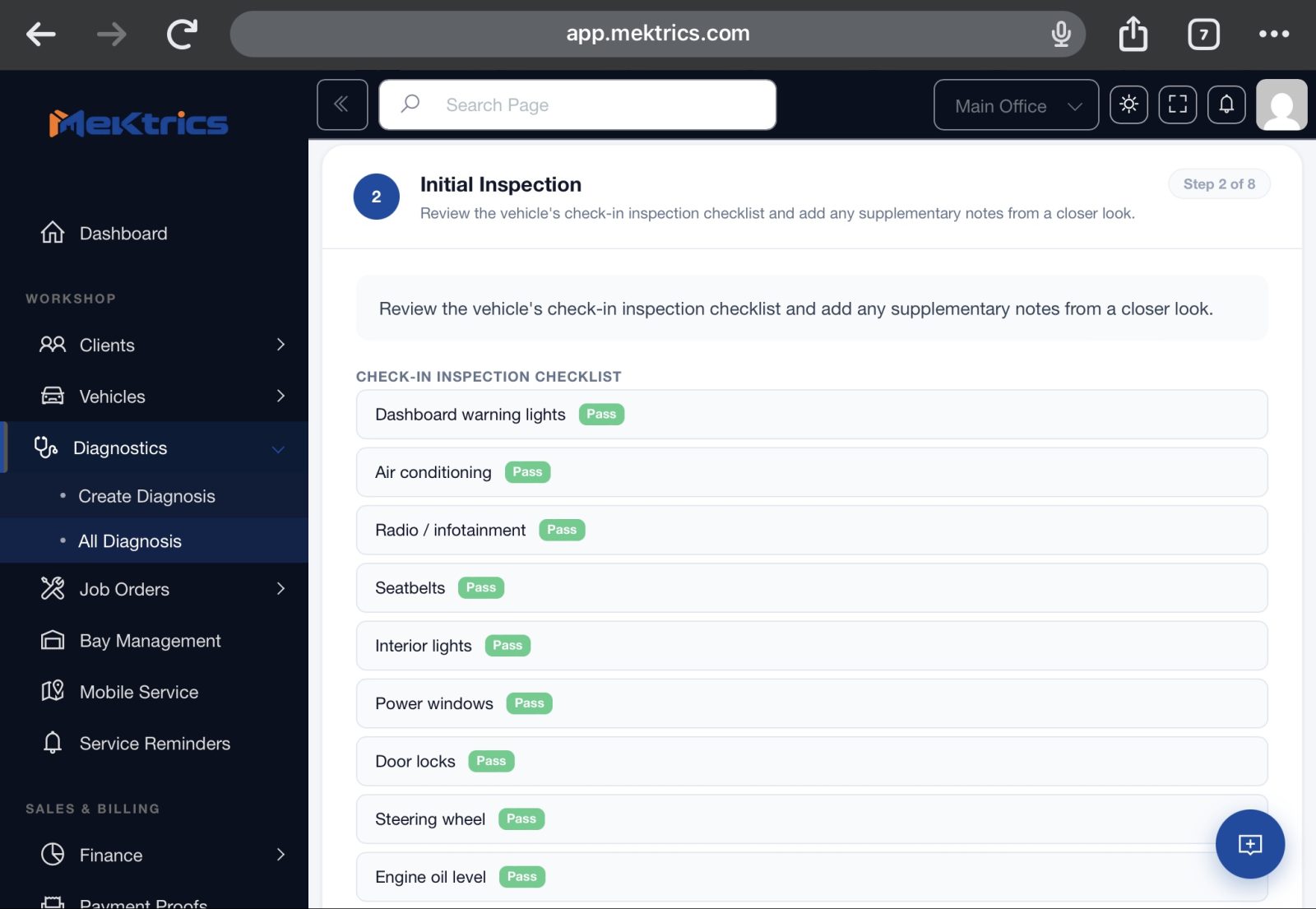
How Mektrics Can Help With Vehicle Service HistoryMektrics is designed around connected workshop records.
A vehicle can be associated with its customer and the workshop activities performed on it.
That means information can flow through the repair process:
Customer
↓
Vehicle
↓
Inspection
↓
Diagnosis
↓
Estimate
↓
Customer Approval
↓
Job Order
↓
Repair
↓
Invoice
↓
Payment
Over time, those individual repair events build a vehicle history.
Instead of asking:
“What did we do to this vehicle last time?”
the workshop can retrieve the relevant record.
This can help technicians, service advisors, workshop owners and customers have a clearer picture of the vehicle's repair history.
How Vehicle History Can Improve Repeat BusinessA vehicle that has visited your workshop before should not feel like a completely new customer.
The workshop already knows:
The vehicle
Previous repairs
Previous complaints
Previous recommendations
Service history
Customer details
Use that information to provide a more informed experience.
For example, if a vehicle returns for another service, staff can review its history before speaking with the customer.
That can make the interaction faster and more professional.
The Long-Term Value of Vehicle RecordsA single vehicle record may seem insignificant.
But hundreds or thousands of vehicle records can become a valuable source of workshop information.
Over time, the workshop can learn:
Which services are most common
Which vehicles require frequent repairs
Which parts are used most often
Which recommendations customers accept
Which customers return regularly
Which services generate the most revenue
How frequently vehicles return
This turns basic record keeping into useful operational data.
A Better Workshop WorkflowInstead of:
Customer arrives → Mechanic remembers → Repair → Paper receipt
use:
Customer → Vehicle → Inspection → Diagnosis → Estimate → Approval → Job → Repair → Invoice → Payment → Service History
The second workflow creates a record that becomes more valuable every time the vehicle returns.
Final ThoughtsVehicle service history is one of the most useful records an auto repair workshop can maintain.
It gives technicians context, helps workshop owners manage operations and gives customers a more organized service experience.
The goal isn't to record information simply for the sake of record keeping.
The goal is to make every future visit easier.
When a customer returns, the workshop should be able to answer questions such as:
What was repaired last time?
What parts were replaced?
What did the technician find?
What did the customer approve?
What recommendations were declined?
How much did the repair cost?
When was the vehicle last serviced?
What should be checked next?
A complete vehicle history helps turn those questions from a memory exercise into a searchable business record.
For a growing mechanic workshop, that is a major step toward a more organized, professional and data-driven operation.

0 Comments