
[Explore Mektrics and see how digital workshop management can help your business.Spare parts are one of the most important—and most difficult—things to manage in an auto repair workshop.
A workshop can have dozens, hundreds or even thousands of different parts moving through its operations. Some parts move every day. Others may sit on a shelf for months. Some are purchased from different suppliers, while others may be supplied by customers.
Without a proper system, it becomes difficult to answer simple questions:
How many brake pads do we have?
Which parts are running low?
What did we buy last month?
Which supplier supplied a particular part?
Which vehicle was a part used on?
How much did that repair actually cost?
Which parts are selling or being used most frequently?
What should we reorder?
Which parts have been sitting in the workshop for too long?
This is why spare parts inventory management is an important part of running a profitable auto repair workshop.
A good inventory system doesn't simply tell you what is sitting on a shelf. It helps connect purchases, stock, repair jobs, parts usage, customers and invoices.
What Is Spare Parts Inventory Management?Spare parts inventory management is the process of recording, organizing, tracking and controlling the parts a workshop purchases and uses.
For an auto repair workshop, this can include:
Brake pads
Brake discs
Oil filters
Air filters
Fuel filters
Spark plugs
Belts
Hoses
Bearings
Suspension components
Batteries
Engine components
Electrical components
Oils and fluids
Tyres
Workshop consumables
Effective inventory management helps a workshop know what it has, what it needs, what has been used and what needs to be purchased.
Why Is Inventory Management Difficult for Mechanic Workshops?
Many workshops start with a simple system.
A mechanic needs a part, someone checks the shelf, and if it isn't available, someone goes to a parts market or calls a supplier.
As the workshop grows, this process becomes harder to control.
A workshop may have:
Multiple technicians requesting parts
Several vehicles being repaired simultaneously
Different suppliers
Parts with similar names
Parts that fit different vehicle models
Parts being purchased at different prices
Customer-supplied parts
Parts returned after a repair
Parts used without being recorded
This can quickly create inventory discrepancies.
Current workshop-management products in Nigeria and across Africa increasingly connect parts usage to job cards and repair records, reflecting how closely inventory and repair operations are linked.
10 Common Spare Parts Inventory Problems1. You Don't Know Your Actual Stock
One of the most common problems is simply not knowing what is currently available.
The records might say you have five units.
The shelf might contain three.
Someone may have already used two on vehicles without updating the records.
Now your inventory record is wrong.
If your stock records cannot be trusted, purchasing decisions become difficult.
2. Parts Are Used Without Being Recorded
A technician may take a part from the shelf because a vehicle needs it.
The repair gets completed.
But nobody records the part.
The workshop has effectively sold or consumed inventory without recording the transaction.
Small discrepancies like this can become significant over time.
3. You Run Out of Important Parts
Imagine a vehicle is already on a lift.
The technician discovers that a particular component needs replacement.
The workshop checks its shelves.
The part isn't available.
Now the vehicle may remain unfinished while someone searches for the part.
This can delay jobs, frustrate customers and reduce workshop productivity.
4. You Buy Too Much Stock
The opposite problem is also possible.
Without reliable inventory information, a workshop may purchase parts simply because someone believes they are running low.
The workshop eventually discovers that it already had several units.
Money has now been tied up in stock that may not move quickly.
5. Parts Become Difficult to Identify
“Brake pad” is not always enough information.
Different vehicle makes, models, engines and years can require different parts.
A useful inventory record should therefore contain enough information to identify the correct item.
Depending on the workshop, that could include:
Part name
Part number
OEM number
Vehicle make
Vehicle model
Vehicle year
Supplier
Purchase price
Selling price
Quantity
For Nigerian parts businesses, current software products are increasingly emphasizing vehicle fitment, part numbers and supplier information rather than treating every item as a generic product.
6. You Don't Know Which Supplier Is Giving You the Best Price
A workshop may buy the same type of part from several suppliers.
If purchase prices aren't recorded, it becomes difficult to compare suppliers.
For example:
Supplier A — ₦45,000
Supplier B — ₦41,000
Supplier C — ₦43,500
Without historical purchase records, staff may simply continue buying from whichever supplier they normally call.
7. Parts Get Lost
Inventory loss doesn't always mean theft.
Parts can disappear because of:
Poor storage
Incorrect recording
Parts transferred between locations
Returned parts not recorded
Damaged parts
Incorrect quantities
Parts used on jobs without being entered into the system
A good inventory process should make discrepancies easier to identify.
8. You Don't Know Your Parts Cost Per Job
This is particularly important for workshop profitability.
Suppose a customer is charged ₦250,000 for a repair.
If the workshop doesn't know exactly how much was spent on parts and labour, it doesn't really know how profitable the job was.
Connecting parts usage to the repair job provides much better visibility.
9. Slow-Moving Parts Tie Up Cash
Not every part moves at the same speed.
Some parts may be used every week.
Others might sit on the shelf for six months.
Slow-moving inventory ties up money that could potentially be used elsewhere in the business.
Workshop owners should therefore pay attention not only to how much stock they have, but also how quickly that stock moves.
10. Inventory Records Become Separate From the Job
This is one of the biggest weaknesses of disconnected systems.
You might have:
Inventory notebook
Job card
Invoice book
Supplier receipts
WhatsApp conversations
Bank records
Each contains part of the story.
The problem is that nobody has the complete picture.
A better system connects those records.
How to Organize Spare Parts in an Auto Repair WorkshopBefore buying software, establish a clear inventory structure.
Step 1: Create Categories
Group parts logically.
For example:
Engine
Oil filters
Air filters
Spark plugs
Belts
Gaskets
Braking
Brake pads
Brake discs
Brake shoes
Brake sensors
Suspension
Shock absorbers
Bushings
Ball joints
Control arms
Electrical
Batteries
Alternators
Sensors
Fuses
Fluids
Engine oil
Brake fluid
Coolant
Transmission fluid
The exact categories should match the type of work your workshop performs.
Step 2: Give Parts Consistent Names
Avoid having the same part entered under several different names.
For example:
“Toyota Camry Brake Pad”
“Camry Front Pad”
“Toyota Brake Pads”
“Brake Pad Camry”
could potentially refer to the same item.
A consistent naming convention makes searching and reporting easier.
Step 3: Record Part Numbers
Where applicable, record:
OEM number
Manufacturer part number
SKU
Supplier code
This reduces confusion between visually similar parts.
Step 4: Record Vehicle Compatibility
Where useful, record which vehicles a part fits.
For example:
Part: Front brake pad
Make: Toyota
Model: Camry
Year: Relevant model years
This is particularly useful when a workshop works on many different vehicle models.
Step 5: Record Purchase Cost
Every stock item should have a known cost where appropriate.
If the same part is purchased at different prices over time, maintain the relevant purchase history rather than assuming the cost never changes.
This information becomes important when calculating job profitability.
How to Track Parts Used on Repair JobsThis is where inventory management connects directly to job cards.
Suppose a vehicle comes into the workshop with a braking problem.
The repair job might use:
1 set of brake pads
2 brake discs
Brake fluid
Labour
The inventory system should record the parts issued to that particular job.
The workflow becomes:
Vehicle → Job Card → Parts Used → Labour → Invoice
This is much more useful than simply reducing inventory manually at the end of the day.
Some current workshop systems explicitly connect parts issued to job cards and deduct stock as those parts are used.
Why Linking Inventory to Job Cards MattersConsider two repair jobs.
Job A
Parts cost: ₦80,000
Labour: ₦30,000
Customer invoice: ₦150,000
Job B
Parts cost: ₦20,000
Labour: ₦50,000
Customer invoice: ₦150,000
Both jobs generated the same revenue.
But their cost structures are completely different.
Without tracking parts and labour against individual jobs, the workshop has limited visibility into this difference.
With connected records, the workshop can understand where its money is going.
This is one reason inventory management should not be treated as a separate activity from workshop management.
How to Know When to Reorder Spare PartsA workshop shouldn't wait until a part reaches zero before thinking about purchasing more.
Set a minimum stock level for important items.
For example:
PartCurrent StockMinimum LevelActionOil filter155MonitorBrake pad set35ReorderSpark plug3010MonitorAir filter48ReorderThe exact levels will depend on the workshop.
A fast-moving part may require a higher minimum stock level than a part that is rarely used.
Some modern inventory systems provide low-stock notifications or reorder alerts when stock reaches a defined threshold.
Track Fast-Moving and Slow-Moving PartsNot every part deserves the same purchasing strategy.
Fast-moving parts
These are frequently used.
Examples might include:
Oil filters
Air filters
Spark plugs
Brake pads
Common fluids
These need closer monitoring.
Slow-moving parts
These may be used occasionally.
Buying too many can tie up cash unnecessarily.
Review your inventory periodically to identify parts that have not moved for a long time.
This can help you make better purchasing decisions.
How to Reduce Spare Parts LossesInventory control isn't only about buying and selling.
It's also about accountability.
Consider creating a process where:
A repair job is created.
The required parts are identified.
Parts are issued to the job.
The technician uses the parts.
Unused parts are returned.
The job is completed.
The inventory record is updated.
This creates a traceable path from stockroom to vehicle.
For larger workshops, it can also be useful to record who issued or handled particular stock transactions.
What About Customer-Supplied Parts?This is common in some workshops.
A customer may purchase a component independently and bring it to the mechanic.
That part should not necessarily be treated as workshop-owned inventory.
The workshop should distinguish between:
Workshop-supplied part
and
Customer-supplied part
This distinction can prevent confusion when calculating:
Parts revenue
Parts cost
Workshop profit
Warranty responsibility
Final invoice
The repair record should make it clear who supplied the component.
Paper Inventory vs Digital InventoryA paper stock book can work for a small workshop.
The basic process might look like:
Part arrives → Write it in book → Part leaves → Reduce quantity
The challenge comes when the workshop becomes busy.
Digital inventory can make it easier to:
Search for parts
View current stock
Track stock movement
Link parts to jobs
Record suppliers
Monitor low stock
Review purchase history
Analyze inventory
The goal isn't to make inventory management more complicated.
It is to make the information easier to trust.
What Should Workshop Inventory Software Include?If you're considering inventory software for your mechanic workshop, look for functionality that matches your actual workflow.
Useful capabilities can include:
Parts catalogue
Store part names, categories, numbers and compatibility information.
Stock levels
Know how much of each part is available.
Stock movement
Record purchases, usage, returns and adjustments.
Supplier management
Know who supplied a part and what it cost.
Job integration
Connect parts used directly to repair jobs.
Low-stock alerts
Know when important items need replenishment.
Purchase records
Keep track of what was purchased and when.
Cost tracking
Understand the cost of parts used on jobs.
Reporting
See which parts are moving and how inventory is performing.
Multi-location support
Important for workshops operating more than one branch.
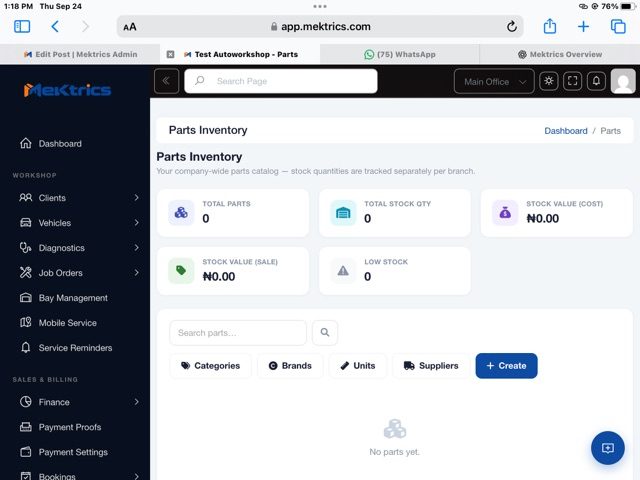
How Mektrics Can Help Manage Workshop InventoryThe biggest advantage of digital workshop management is that inventory doesn't have to exist in isolation.
With Mektrics, workshop operations can be organized around the relationship between customers, vehicles, jobs, technicians, parts, invoices and payments.
That means the parts used during a repair can be part of the same operational record as the job itself.
Instead of asking:
“Where did that part go?”
the workshop can work toward a more structured process:
Part → Job → Vehicle → Customer → Invoice
This is especially useful when a workshop has multiple technicians or handles many vehicles at the same time.
It also builds naturally on the digital job-card workflow discussed in our previous article.
How to Start Improving Your Workshop Inventory TodayYou don't need to digitize thousands of parts on the first day.
Start with your most important inventory.
Start with your fast-moving parts
Identify the parts your workshop uses most often.
Count your current stock
Establish a reliable starting point.
Standardize names
Remove duplicate or confusing product names.
Add part numbers
Where applicable, record OEM or manufacturer numbers.
Record suppliers
Know where your parts came from.
Record purchase prices
This helps you understand costs.
Connect parts to jobs
Make sure parts used during repairs are recorded against the correct vehicle and job.
Set minimum stock levels
Identify the parts you don't want to run out of.
Review inventory regularly
Look for discrepancies, slow-moving items and unnecessary purchases.
Frequently Asked QuestionsWhat is spare parts inventory management?
Spare parts inventory management is the process of tracking the parts a workshop purchases, stores, uses, returns and replaces.
Why is inventory management important for a mechanic workshop?
It helps the workshop know what it has available, reduce stock discrepancies, avoid unnecessary purchases, reduce shortages and understand the cost of parts used on repair jobs.
How do I track spare parts used by mechanics?
Ideally, record each part against the relevant repair job or job card. This connects the part to the vehicle and customer and makes stock movement easier to track.
How do I know when to reorder parts?
Set minimum stock levels for important parts and monitor how quickly those parts are being used. When stock reaches the defined threshold, reorder according to your supplier lead time and expected demand.
Should customer-supplied parts be included in workshop inventory?
They should generally be distinguished from workshop-owned stock. Record them against the repair job without treating them as parts purchased and owned by the workshop.
Is inventory software necessary for a small mechanic workshop?
Not every small workshop needs sophisticated software immediately. However, once the number of vehicles, technicians and parts increases, digital inventory management can make stock control considerably easier.
Can inventory management help a workshop make more profit?
Yes, better inventory records can help a workshop understand parts costs, reduce unnecessary purchases, identify losses and calculate the economics of individual repair jobs more accurately.
Final ThoughtsSpare parts are cash sitting on your shelves.
If you don't know what you have, where it came from, what it cost or where it went, part of your workshop's financial picture is missing.
Good inventory management gives you greater control.
It helps you know:
What came in.
What is available.
What was used.
Which vehicle used it.
What it cost.
What needs to be reordered.
And when inventory is connected to your job cards, invoices and customer records, it becomes more than stock control.
It becomes part of your workshop's operating system.
For workshops moving from paper-based processes to digital management, this is one of the most valuable areas to improve.
Manage your parts. Track your jobs. Understand your costs. Run your workshop with better information.
Explore Mektrics and see how digital workshop management can help your business.

0 Comments