
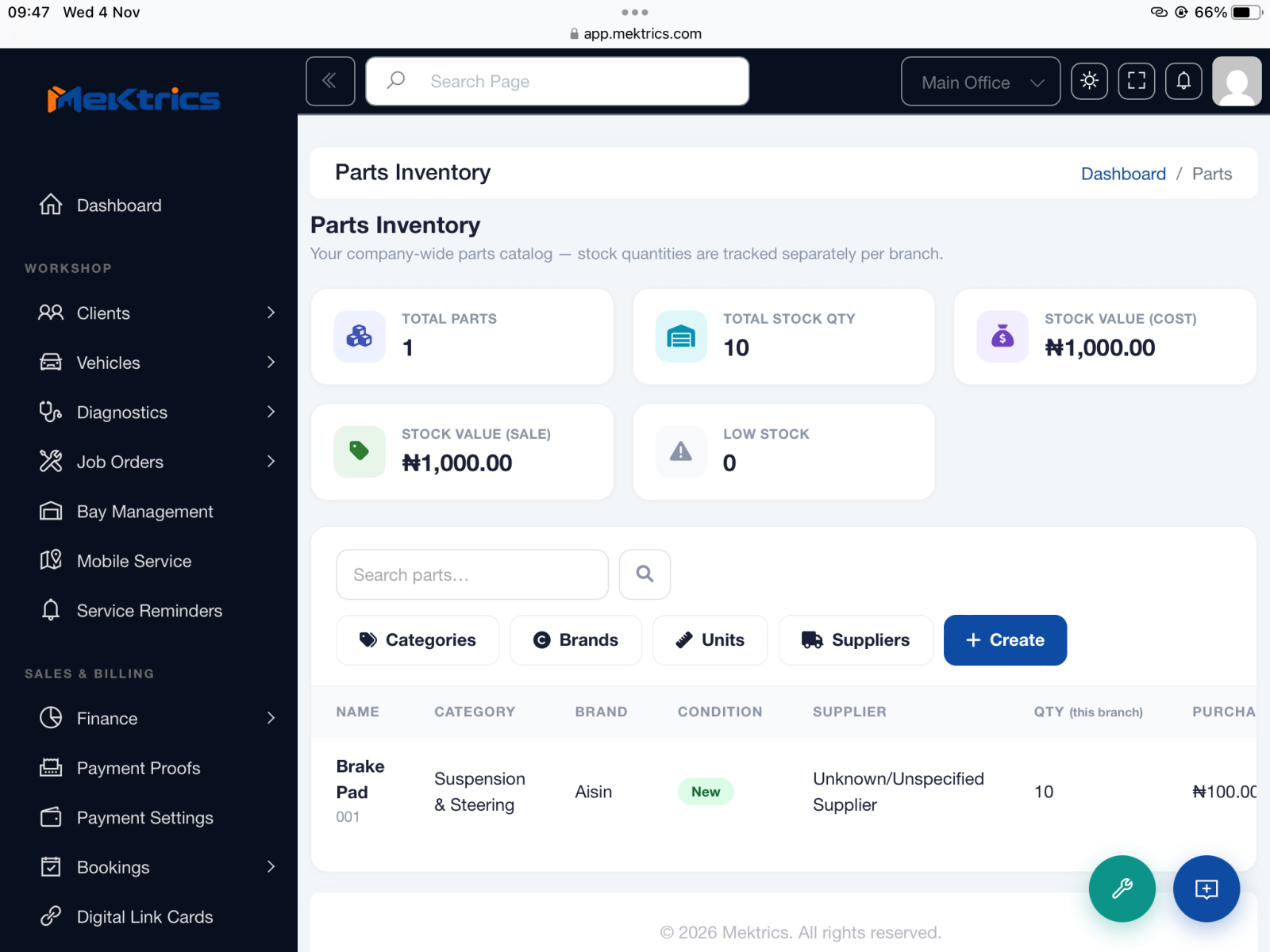
- Spare parts management is an important part of running a successful auto repair workshop. Whether you operate a small garage or a busy automotive service centre, having the right parts available at the right time can make a significant difference to your daily operations.
When spare parts are poorly managed, workshops may experience repair delays, unnecessary expenses, misplaced components, and frustrated customers. Mechanics may have to stop working because a required part is unavailable, while workshop owners may spend money purchasing items they already have.
Good spare parts management helps reduce these problems and keeps repair jobs moving.
Here are practical ways to manage spare parts more efficiently in your auto repair workshop.
1. Know Which Spare Parts Your Workshop Uses Frequently
Start by identifying the parts your workshop regularly needs.
Different workshops have different customer bases and service specialities. A workshop that handles mostly Japanese vehicles may frequently use different components from one that specializes in European vehicles.
Review your previous repair jobs and identify commonly used items such as:
Oil filters.
Air filters.
Spark plugs.
Brake pads.
Engine oil.
Belts.
Common electrical components.
Frequently replaced suspension components.
Understanding your most frequently used parts helps you make better purchasing decisions and avoid unnecessary stock.
2. Keep a Clear Record of Spare Parts Purchased
Every spare part purchased for your workshop should be properly documented.
Record important details such as the part name, quantity, purchase date, supplier, cost, and vehicle or job it was purchased for.
Without proper records, it becomes difficult to know how much your workshop spends on parts or identify where certain components have gone.
Even if you operate a small workshop, maintaining a simple purchasing record can improve financial control.
3. Organize Spare Parts Properly
Keeping spare parts in random locations creates confusion and wastes time.
Mechanics should not have to search through several boxes or shelves to find a commonly used component.
Organize your parts according to categories, vehicle types, or component groups. Use labels to identify storage locations and ensure that frequently used items are easy to access.
A well-organized storage area makes it easier to identify available parts and reduces the chances of losing components.
4. Check Your Stock Regularly
Do not wait until a mechanic needs a part before discovering that it is unavailable.
Carry out regular stock checks to understand which parts are available, which are running low, and which have not been used for a long time.
A simple stock review can help you identify:
Parts that need to be replenished.
Items that are taking up unnecessary storage space.
Components that are frequently misplaced.
Parts that have become damaged or unusable.
Regular checks help workshop owners make informed purchasing decisions.
5. Avoid Buying Too Many Unnecessary Parts
Having spare parts available is useful, but buying too much stock can tie up money that could be used for other business expenses.
Some components may remain unused for months, especially if they are specific to certain vehicle models.
Before purchasing parts in large quantities, consider how frequently they are used, how quickly they can be sourced, and whether there is sufficient demand.
Maintain reasonable quantities of frequently used items while purchasing less common components when required.
6. Work With Reliable Spare Parts Suppliers
Your suppliers can have a major impact on how efficiently your workshop operates.
A supplier who consistently delivers the correct parts on time can help prevent unnecessary repair delays.
When choosing suppliers, consider:
Product quality.
Availability of parts.
Delivery time.
Pricing.
Return and replacement policies.
Reliability and communication.
Do not choose a supplier based on price alone. A cheap but unreliable component can lead to additional repair costs and customer dissatisfaction.
7. Confirm the Correct Part Before Purchasing
Ordering the wrong spare part can waste money and delay repairs.
Before purchasing a component, confirm the vehicle's make, model, year, engine type, and any other relevant specifications.
Where necessary, use the vehicle identification number (VIN) or the manufacturer's part number to verify compatibility.
Mechanics and purchasing staff should communicate clearly to ensure that the correct component is ordered.
This is particularly important for vehicles with different engine variants or similar-looking components.
8. Link Spare Parts to the Correct Repair Job
One common challenge in busy workshops is knowing which repair job a purchased component belongs to.
A part may arrive at the workshop but remain unused because nobody knows which vehicle or customer it was purchased for.
Whenever a component is purchased for a specific repair, record the relevant job or vehicle details.
This makes it easier to track parts, control repair expenses, and prevent confusion when several vehicles are being serviced at the same time.
9. Monitor How Spare Parts Affect Repair Costs
Spare parts are an important component of repair pricing.
Workshop owners should understand how much is spent on components for each job and ensure that these costs are properly considered when preparing estimates.
Failing to account for parts expenses can reduce the profit made from a repair.
Maintain clear records of parts purchased and the costs associated with each repair. This helps you prepare more accurate estimates and understand the financial performance of your workshop.
10. Use Technology to Organize Workshop Operations
Managing workshop activities through notebooks, loose papers, and memory can become difficult as the number of customers and repair jobs increases.
Digital workshop management systems help organize important information about customers, vehicles, inspections, estimates, and job orders.
Mektrics helps auto repair workshops manage these activities through an organized digital workflow. Workshop owners can register customers and vehicles, carry out vehicle inspections, document diagnosis, prepare estimates, and manage repair jobs.
While good parts storage and purchasing procedures remain essential, organized digital repair records can make it easier to understand which vehicle is being serviced and what work has been assigned.
Conclusion
Efficient spare parts management helps auto repair workshops reduce unnecessary expenses, prevent avoidable delays, and improve the overall repair process.
By organizing parts, monitoring stock, working with reliable suppliers, confirming compatibility, and keeping accurate purchasing records, workshop owners can maintain better control over their operations.
As your workshop grows, combining good inventory practices with organized digital management can help you work more efficiently and deliver a better experience to your customers.
Want to organize your workshop operations more effectively? Explore Mektrics and discover how digital tools can help you manage customers, vehicles, inspections, estimates, and repair jobs. Visit mektrics.com.

0 Comments