
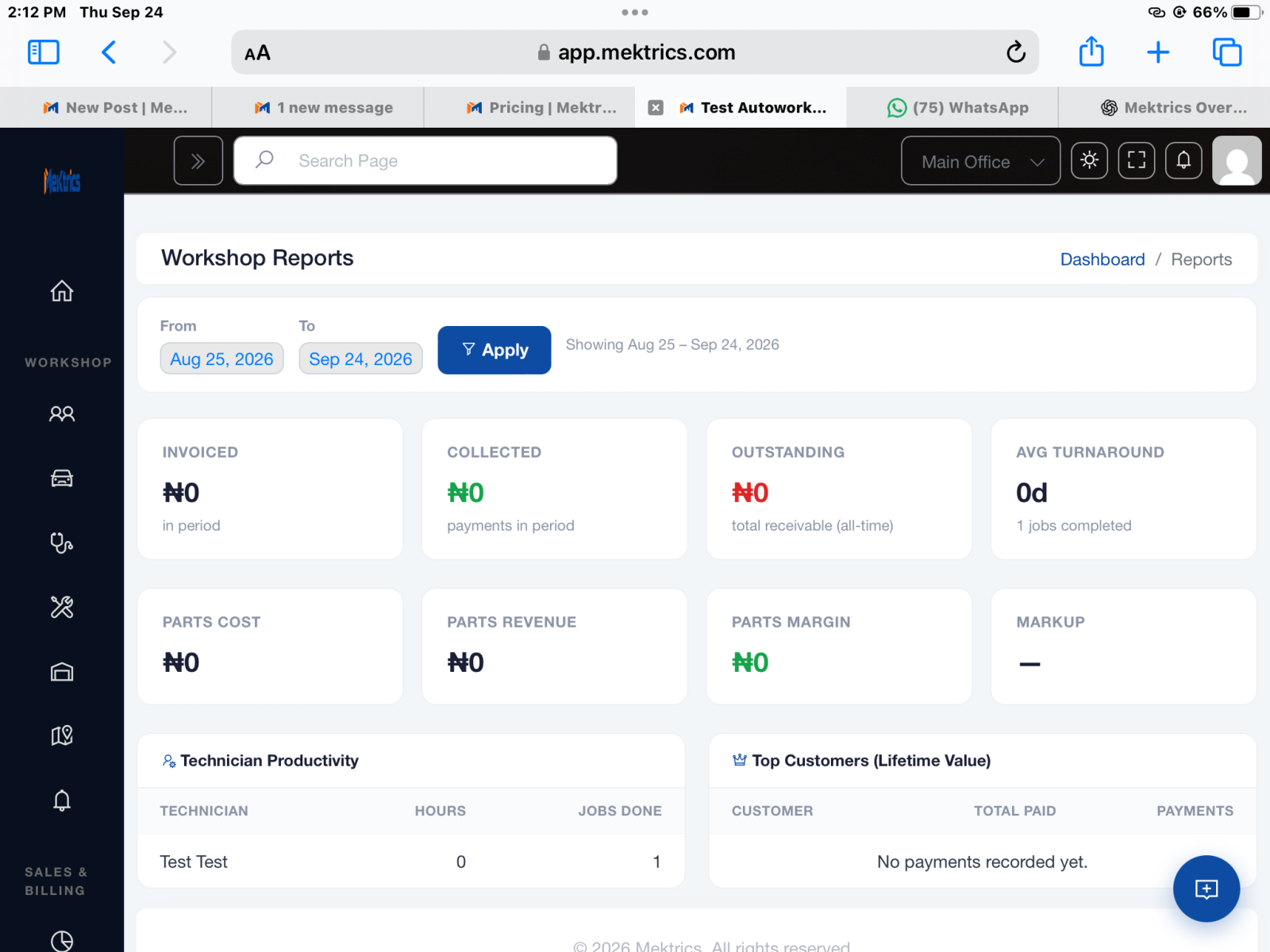
- Running a busy auto repair workshop does not automatically mean running a profitable business.
You can have vehicles coming in every day, technicians working from morning until evening, and a steady stream of customers—and still find that there isn't enough money left at the end of the month.
Why?
Because revenue and profit are not the same thing.
A workshop can increase sales while also increasing expenses, parts costs, unpaid invoices, discounts, idle technician time and other operating costs.
To increase profit, workshop owners need to understand where money is being generated, where it is being lost and which parts of the operation can be improved.
This guide explains practical ways to increase auto repair workshop profitability, particularly for independent workshops and mechanic businesses in Nigeria.
What Is Workshop Profitability?At its simplest:
Profit = Revenue − Costs
Revenue can come from:
Labour
Spare parts
Vehicle servicing
Diagnostics
Repairs
Inspections
Tyres
Batteries
Other workshop services
Costs may include:
Spare parts
Technician wages
Staff salaries
Rent
Electricity
Equipment
Tools
Fuel
Software
Taxes and fees
Marketing
Transport
Other operating expenses
The goal isn't necessarily to charge customers more.
The goal is to build a workshop where the value generated by each job is greater than the cost of delivering it.
1. Know Your Profit Per Repair JobOne of the biggest mistakes a workshop can make is looking only at total monthly revenue.
Suppose your workshop generated:
₦8,000,000 in sales
That sounds impressive.
But what did it cost to generate those sales?
If direct costs were ₦6,500,000, the remaining amount before other operating expenses would be:
₦1,500,000
Now compare that with another month:
Revenue: ₦7,000,000
Direct costs: ₦5,000,000
Gross profit: ₦2,000,000
The second month generated less revenue but more gross profit.
This is why workshop owners should understand the economics of individual repair jobs rather than focusing only on sales.
A useful repair-job record should connect:
Customer → Vehicle → Job → Parts → Labour → Invoice → Payment
That makes it easier to understand what each job contributes to the business.
2. Stop Guessing Your Parts CostsSpare parts can have a major impact on workshop profitability.
If you don't know what a part cost the workshop, it becomes difficult to know whether the price charged to the customer is appropriate.
For every important part, try to maintain:
Part name
Part number
Supplier
Purchase cost
Selling price
Quantity
Vehicle compatibility
Date purchased
This also makes it easier to compare supplier prices.
For example, if one supplier sells a part for ₦45,000 and another sells it for ₦39,000, knowing your purchase history gives you better information when making purchasing decisions.
Your spare-parts inventory system should therefore be connected to your repair jobs.
3. Price Parts ConsistentlyA workshop needs a clear approach to parts pricing.
If technicians or staff quote different prices for the same part without a consistent reason, profitability becomes difficult to control.
A workshop can establish pricing rules based on factors such as:
Purchase cost
Supplier price changes
Part availability
Warranty considerations
Handling costs
Market conditions
Desired margin
The exact markup or margin a workshop chooses is a business decision and may vary significantly depending on the part and market.
The important thing is consistency and visibility.
If a part costs ₦30,000 and the workshop sells it for ₦40,000:
Gross profit = ₦10,000
If the same part is repeatedly sold at ₦33,000 without considering the workshop's costs, the margin is much smaller.
The workshop needs to know the difference.
4. Track Labour ProperlyParts aren't the only cost in a repair.
Labour is another major component.
If a workshop charges customers for labour but doesn't track how much time technicians spend on jobs, it becomes difficult to understand labour profitability.
Track information such as:
Technician
Job
Labour item
Time spent
Labour charge
Job completion time
This can help answer questions such as:
Which jobs consume the most technician time?
Are some jobs consistently taking longer than expected?
Are technicians spending time waiting for parts?
Are some technicians underutilized?
Good labour tracking doesn't mean rushing technicians.
It means understanding how workshop time is being used.
5. Reduce Technician Idle TimeA technician cannot generate labour revenue while waiting for something unrelated to the repair itself.
Common causes of downtime can include:
Waiting for parts
Waiting for customer approval
Waiting for diagnostic information
Searching for tools
Waiting for another technician
Poor job assignment
Vehicles not being ready
Unclear instructions
This is why workshop workflow matters.
For example:
Vehicle arrives
↓
Inspection
↓
Diagnosis
↓
Estimate
↓
Customer approval
↓
Parts available
↓
Technician assigned
↓
Repair
↓
Quality check
↓
Customer collection
The smoother this process becomes, the less time is lost between stages.
6. Reduce Jobs Waiting for PartsA vehicle sitting in the workshop while waiting for a part can consume valuable capacity.
Suppose your workshop has six service bays.
If two vehicles occupy bays for several days because required parts aren't available, only four bays may be available for other work.
That can affect:
Job throughput
Technician utilization
Customer waiting time
Revenue opportunities
Better inventory management can help.
Track your fast-moving parts and establish appropriate minimum stock levels.
For a deeper look at this topic, see our guide to spare parts inventory management for auto repair workshops.
7. Don't Undercharge for Your ExpertiseMany mechanics focus heavily on parts prices while treating labour as something customers should pay very little for.
But a professional repair involves more than turning a spanner.
The customer is also paying for:
Technical knowledge
Diagnosis
Experience
Tools
Workshop equipment
Technician time
Testing
Quality control
Responsibility for the repair
If your labour pricing does not adequately reflect the resources required to perform the work, high sales volume may not translate into sustainable profit.
Review your labour pricing periodically against:
Technician costs
Workshop overhead
Job complexity
Time required
Equipment used
Market conditions
A workshop can lose potential revenue simply because customers don't understand the recommended work.
Consider a situation where a technician identifies:
Brake issue — urgent
Worn suspension component — recommended
Minor fluid leak — monitor
If the customer receives only a single unexplained total, they may hesitate.
A professional estimate should make the work understandable.
Explain:
What was found
Why the repair is needed
What happens if it is ignored
Parts required
Labour required
Total cost
Customers still decide what they want to approve.
The workshop's job is to communicate the information clearly.
9. Follow Up on Declined WorkNot every customer will approve every recommendation immediately.
A customer may say:
"I'll come back next week."
That shouldn't necessarily be the end of the conversation.
If the customer has consented to follow-up communication, the workshop can maintain a record of recommended work and follow up appropriately.
This is especially useful for:
Preventive maintenance
Tyres
Batteries
Brake work
Suspension
Other non-emergency repairs
A workshop that keeps proper vehicle and customer history can make these follow-ups more organized.
10. Reduce Unpaid Customer BalancesA workshop can be profitable on paper but experience cash-flow problems if customers don't pay on time.
Track:
Invoice amount
Amount paid
Balance
Payment date
Payment method
Outstanding age
For example:
Invoice: ₦300,000
Paid: ₦200,000
Outstanding: ₦100,000
If outstanding balances accumulate across dozens of customers, the total can become significant.
Clear estimates, invoices and payment policies can help reduce confusion.
For business customers or fleet customers, agreed payment terms should be documented clearly.
11. Reduce Parts and Inventory LossesNot every inventory loss is theft.
Stock can disappear because of:
Poor recording
Incorrect quantities
Damaged parts
Returns not recorded
Parts issued to the wrong job
Customer-supplied parts being mixed with workshop stock
Parts being taken without proper documentation
The solution is accountability.
When a part leaves inventory, the workshop should ideally know:
What part?
How many?
Which job?
Which vehicle?
Who handled the transaction?
Digital inventory systems can make this easier than relying entirely on handwritten stock books.
12. Retain More CustomersGetting a new customer usually requires more effort than serving an existing customer who already knows the workshop.
Customer retention can therefore be an important part of workshop growth.
Create a professional customer experience around:
Accurate estimates
Clear communication
Quality repairs
Proper invoices
Vehicle history
Service reminders
Follow-up
Convenient appointments
A customer's vehicle also creates future opportunities.
For example, if a vehicle comes in for an oil service today, its history may indicate that other maintenance will be due later.
A workshop that keeps good records can follow up more systematically.
13. Track Your Workshop KPIsYou can't improve what you don't measure.
At minimum, consider tracking:
Repair order count
Average repair order
Total revenue
Gross profit
Parts margin
Technician productivity
Estimate approval rate
Jobs waiting for parts
Outstanding balances
Customer return rate
These numbers help you identify where the workshop is performing well and where further investigation is needed.
For example:
Revenue is increasing but profit isn't
Investigate:
Parts costs
Discounts
Labour costs
Operating expenses
Jobs are increasing but completion is slowing
Investigate:
Technician capacity
Parts availability
Bay utilization
Workflow bottlenecks
Customers are coming in but average repair value is falling
Investigate:
Type of work
Estimate approval
Pricing
Recommended maintenance
Customer mix
KPIs don't tell you the entire story.
They tell you where to look.
Profitability Is Not Just About Increasing PricesWhen a workshop owner wants to increase profit, the first idea is sometimes:
Raise prices.
Price can certainly affect profitability, but it isn't the only lever.
A workshop can also improve profitability by:
Reducing unnecessary inventory
Reducing parts losses
Improving technician utilization
Reducing idle time
Increasing estimate approval
Reducing unpaid balances
Improving customer retention
Improving purchasing
Reducing rework
Completing jobs more efficiently
This is important because profitability can improve through better operations, not just higher prices.
Understand the Difference Between Revenue, Gross Profit and Net ProfitThese terms are sometimes confused.
Revenue
Money generated from sales.
Gross Profit
Revenue minus direct costs associated with producing the work.
Net Profit
What remains after the business's expenses have been accounted for.
A simplified example:
Revenue: ₦10,000,000
Direct costs: ₦6,000,000
Gross profit: ₦4,000,000
Then suppose operating expenses are:
Rent: ₦700,000
Salaries: ₦1,000,000
Electricity: ₦300,000
Fuel: ₦200,000
Other expenses: ₦300,000
Total operating expenses: ₦2,500,000
Simplified remaining profit:
₦4,000,000 − ₦2,500,000 = ₦1,500,000
The exact accounting treatment will depend on the business, but the example demonstrates why sales alone don't tell you how profitable a workshop is.
How Software Can Help Improve Workshop ProfitabilityWorkshop profitability depends partly on having reliable information.
If customer information is in one notebook, job cards are on paper, inventory is tracked separately and payments are recorded somewhere else, connecting the numbers becomes difficult.
A workshop-management system can bring the workflow together:
Customer
↓
Vehicle
↓
Job Card
↓
Inspection
↓
Estimate
↓
Parts + Labour
↓
Invoice
↓
Payment
↓
Vehicle History
↓
Reporting
This gives the workshop a clearer operational record.
It also makes it easier to connect individual repair jobs with the financial information generated by those jobs.
How Mektrics Can HelpMektrics brings workshop operations into one connected system.
Depending on the workshop's workflow, this can include:
Customers
Vehicles
Job orders
Inspections
Technicians
Parts and inventory
Estimates
Invoices
Payments
Appointments
Staff management
Reports
Vehicle service history
The objective isn't simply to replace a paper job card.
It's to create a connected system where information generated during a repair can be used throughout the business.
For example:
A vehicle enters the workshop.
↓
A job is created.
↓
The vehicle is inspected.
↓
The required work is estimated.
↓
Parts are assigned to the job.
↓
A technician performs the repair.
↓
Labour and parts are recorded.
↓
An invoice is created.
↓
Payment is recorded.
↓
The repair becomes part of the vehicle's history.
That information can then contribute to the workshop's operational reporting.
A Simple Profit Improvement ChecklistIf you're a workshop owner trying to improve profitability, start here.
Every day
Record every repair job
Record parts used
Record labour
Record payments
Update job status
Record outstanding balances
Every week
Review completed jobs
Review parts usage
Review jobs waiting for parts
Check outstanding invoices
Review technician workload
Identify unfinished jobs
Every month
Calculate revenue
Calculate gross profit
Review parts margin
Review labour performance
Review average repair order
Review customer retention
Identify unnecessary expenses
Review slow-moving inventory
Then choose a few areas to improve.
Don't try to change everything simultaneously.
Frequently Asked QuestionsHow can I increase profit in my mechanic workshop?
Start by understanding your revenue and costs. Then focus on areas such as parts margins, labour pricing, technician utilization, inventory losses, unpaid invoices, estimate approval and customer retention.
How do I calculate profit per repair job?
A simple approach is to subtract the direct costs associated with the repair—such as parts and applicable labour—from the revenue generated by the job.
Should I increase my mechanic labour rates?
Labour pricing should reflect your workshop's costs, expertise, equipment, time requirements and market conditions. Review your current pricing against your actual costs rather than changing prices arbitrarily.
How does inventory affect workshop profit?
Inventory affects both cash and repair-job costs. Excess stock can tie up capital, while shortages can delay repairs. Accurate inventory records help workshops make better purchasing and pricing decisions.
How can I get customers to approve more repairs?
Provide clear estimates and explain what was found, why the repair matters and what work is recommended. Customers make the final decision, but better communication can make the decision easier.
Can workshop software improve profitability?
Software does not automatically make a workshop profitable. Its value comes from giving the workshop better information and control over customers, jobs, parts, labour, invoices, payments and performance.
What is the most important workshop KPI?
There isn't one KPI that tells you everything. Revenue, gross profit, average repair order, parts margin, technician productivity, outstanding balances and customer retention each provide different information.
Final ThoughtsA profitable auto repair workshop isn't necessarily the workshop with the most vehicles outside its gate.
It's the workshop that understands how its work turns into revenue, how revenue turns into gross profit, and where money is being lost along the way.
Start by knowing your numbers.
Track your repair jobs.
Track your parts.
Track your labour.
Track your invoices.
Track your payments.
Track your customers.
Then use that information to identify opportunities to improve.
For a growing mechanic workshop, the goal isn't simply:
"Get more cars."
It's:
Get the right work, price it properly, control your costs, complete it efficiently, collect payment, and build relationships that bring customers back.
That is how better workshop operations can contribute to better profitability.
Ready to bring your workshop operations together? Explore Mektrics and see how digital workshop management can help you manage jobs, customers, vehicles, inventory, invoices and payments in one place.

0 Comments