
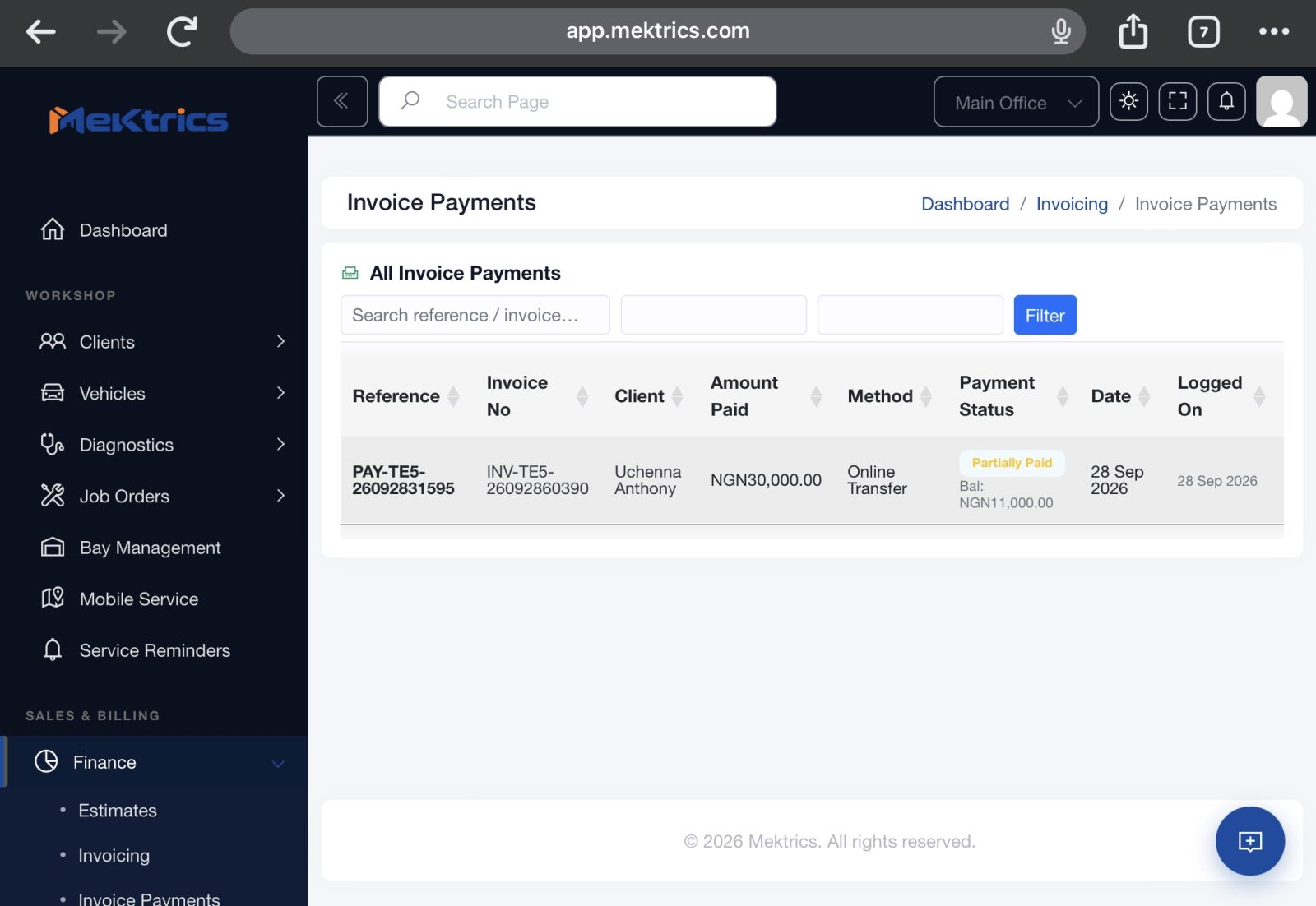
- Once a mechanic workshop completes a repair, there is one important step before the vehicle leaves the workshop: creating an accurate invoice.
An auto repair invoice tells the customer exactly what work was completed, which parts were used, what labour was performed and how much is owed.
For a workshop, an invoice is more than a receipt. It creates a record of the transaction and connects the completed repair to the customer, vehicle and payment.
Without a proper invoicing process, workshops can struggle with:
Unpaid customer balances
Confusion over repair costs
Missing payment records
Incorrect parts charges
Unclear labour charges
Disputes over completed work
Difficulty tracking revenue
Poor financial records
A professional invoicing process helps prevent these problems.
This guide explains how to create an auto repair invoice, what information to include, how invoices differ from estimates, common mistakes to avoid and how digital invoicing can improve workshop operations.
What Is an Auto Repair Invoice?
An auto repair invoice is a document that records the charges for repair, maintenance or other automotive services provided by a workshop.
It normally includes:
Customer details
Vehicle details
Invoice number
Date
Completed services
Parts used
Labour charges
Other applicable charges
Total amount
Amount paid
Outstanding balance
Payment information
Warranty or service notes where applicable
The invoice should reflect the work and items that were actually supplied or completed.
This is different from an estimate, which communicates expected costs before the repair is completed.
Auto Repair Estimate vs InvoiceUnderstanding the difference is important.
Estimate
An estimate answers:
“How much is this repair expected to cost?”
It is created before or during the approval stage.
Invoice
An invoice answers:
“What does the customer owe for the work and items that were actually provided?”
It is normally created after the relevant work has been completed or charges have been established.
A typical workshop workflow therefore looks like:
Inspection → Diagnosis → Estimate → Customer Approval → Job Order → Repair → Invoice → Payment
This connection is important because the final invoice should not become a surprise to the customer.
Why Proper Invoicing Matters for a Mechanic Workshop1. It Creates a Clear Record
Every completed repair should leave a record.
An invoice can show:
What was repaired
Which parts were supplied
Labour performed
Amount charged
Payment status
Date of service
This information becomes useful when the customer returns.
2. It Helps Workshops Collect Payments
An invoice gives the customer a clear amount due.
Instead of relying on memory or handwritten notes, the workshop has a documented balance.
For example:
Invoice total: ₦X
Amount paid: ₦X
Balance: ₦X
This makes outstanding payments easier to track.
3. It Reduces Customer Disputes
A vague invoice can create questions.
For example:
Repair — ₦X
What exactly was repaired?
A better invoice could show:
Front brake pad replacement — ₦X
Brake inspection — ₦X
Labour — ₦X
Clear descriptions make the transaction easier to understand.
4. It Helps Track Workshop Revenue
Invoices provide valuable financial information.
A workshop can use them to track:
Daily sales
Weekly revenue
Monthly revenue
Parts revenue
Labour revenue
Outstanding balances
Payment methods
Revenue by branch
Revenue by technician or job where applicable
This information becomes increasingly important as the workshop grows.
What Should an Auto Repair Invoice Include?A professional invoice doesn't have to be complicated.
However, it should contain enough information to clearly identify the transaction.
1. Workshop Information
Include:
Workshop name
Address
Phone number
Email or website where applicable
Business registration information where applicable
Other relevant business details
This identifies the business issuing the invoice.
2. Invoice NumberEvery invoice should have a unique reference number.
For example:
INV-2026-00125
A consistent numbering system makes invoices easier to find.
Avoid relying only on dates or customer names.
3. Invoice DateRecord when the invoice was issued.
For example:
Invoice date: 1 October 2026
You may also record the vehicle's repair or service date separately where useful.
4. Customer InformationInclude:
Customer name
Phone number
Email where applicable
Customer reference number where applicable
For fleet customers, include the company or fleet information.
5. Vehicle InformationThis is particularly important for auto repair businesses.
Include:
Vehicle make
Model
Year where relevant
Registration number
VIN where available
Mileage
For a customer with multiple vehicles, vehicle identification prevents the invoice from being attached to the wrong vehicle.
6. Job or Repair ReferenceConnect the invoice to the relevant job order.
For example:
Job Order: JO-2026-00458
This makes it easier to trace:
Invoice → Job → Vehicle → Customer
7. Description of WorkThe invoice should explain what was actually done.
Avoid descriptions such as:
Service — ₦X
when more detail is appropriate.
Instead:
Engine oil and oil filter replacement
or:
Front brake pad replacement and brake system inspection
Clear descriptions help the customer understand the charge.
8. PartsList parts separately where appropriate.
Example:
PartQtyUnit PriceTotalBrake pads1 set₦X₦XBrake cleaner1₦X₦XThis makes the parts portion of the invoice transparent.
9. LabourLabour should also be clearly identified.
Example:
LabourQtyRateTotalBrake system service1₦X₦XA workshop can use hourly labour rates or predefined service prices depending on its business model.
10. Diagnostic ChargesIf the customer was charged for diagnostic work, include it.
For example:
Computer diagnostic scan — ₦X
or:
Electrical diagnostic inspection — ₦X
The description should communicate what the charge relates to.
11. Other ChargesDepending on the job, an invoice may include:
Mobile service fee
Towing
Specialized testing
Consumables
Subcontracted services
Other agreed charges
Only include charges relevant to the completed transaction.
12. Total AmountThe customer should be able to immediately identify the total.
For example:
Parts: ₦X
Labour: ₦X
Diagnostics: ₦X
Other charges: ₦X
Total: ₦X
If taxes or other applicable charges apply, present them clearly.
13. Payment StatusThe invoice should show whether it has been paid.
For example:
Invoice total: ₦X
Paid: ₦X
Balance: ₦X
Possible statuses include:
Paid
Partially paid
Unpaid
Overdue
Cancelled or voided where applicable
A clear status helps workshop staff immediately understand what remains outstanding.
How to Create an Auto Repair Invoice Step by StepStep 1: Complete the Repair
The invoice should be based on the actual work performed.
Before invoicing, confirm that the job has been completed or that the billable work for the current stage has been properly recorded.
Step 2: Review the Approved Estimate
Compare the completed work against the approved estimate.
Check:
Approved repairs
Parts
Labour
Additional work
Revised charges
If additional work was performed, make sure it was properly communicated and approved where required.
Step 3: Record the Parts Used
Identify the parts actually used on the vehicle.
This is particularly important when the workshop maintains inventory.
The parts used on a repair should be connected to the relevant job.
Step 4: Record Labour
Add the labour associated with the completed work.
This can be based on:
Labour hours
Standard labour price
Repair type
Technician/service category
The workshop should use a consistent pricing method.
Step 5: Add Other Charges
Include applicable:
Diagnostics
Consumables
Mobile service
Towing
Specialized services
Review the charges before issuing the invoice.
Step 6: Calculate the Total
Check the arithmetic.
A basic calculation is:
Total = Parts + Labour + Diagnostics + Other Applicable Charges
If discounts or taxes apply, make them visible rather than hiding them inside unrelated line items.
Step 7: Review the Invoice
Before sending it, verify:
Customer
Vehicle
Invoice number
Job number
Parts
Labour
Prices
Quantities
Total
Amount paid
Balance due
A short review can prevent unnecessary corrections later.
Step 8: Send the Invoice
The invoice can be provided through the workshop's chosen communication channel.
Depending on the workflow, this may include:
Printed copy
Email
Customer portal
Messaging platform
Digital customer account
The important thing is that the customer receives a clear record.
Example Auto Repair InvoiceBelow is an illustrative example using placeholder values.
WORKSHOP NAME
Invoice: INV-2026-00125
Date: 1 October 2026
Job Order: JO-2026-00458
Customer
Name: Example Customer
Phone: 080X XXX XXXX
Vehicle
Vehicle: Toyota Example
Registration: ABC-123-XX
Mileage: XXXX km
Completed Work
DescriptionQtyUnit PriceTotalBrake pads1 set₦X₦XBrake cleaning consumables1₦X₦XBrake service labour1₦X₦XSubtotal: ₦X
Other applicable charges: ₦X
Total: ₦X
Amount Paid: ₦X
Balance Due: ₦X
Payment Status: Partially Paid
Notes: Additional approved work, if any, should be reflected in the invoice.
The amounts above are illustrative. A workshop should use its actual prices and applicable charges.
How to Handle an Invoice When the Final Cost Is Higher Than the EstimateThis is one of the most important parts of workshop invoicing.
Suppose:
Approved estimate: ₦X
During the repair, the technician discovers another problem.
The additional repair costs:
₦X
The workshop should not simply surprise the customer with a final invoice of:
₦X
Instead, the additional work should be communicated and approved through the workshop's process.
The final invoice can then show:
Original approved work: ₦X
Additional approved work: ₦X
Final total: ₦X
This maintains a clear connection between the estimate and invoice.
What If the Final Cost Is Lower Than the Estimate?That should also be reflected accurately.
For example:
Estimated: ₦X
Actual: ₦X
The invoice should reflect what was actually supplied or completed, according to the workshop's agreed pricing and terms.
The goal is accuracy—not simply matching the original estimate.
How to Handle Partial PaymentsCustomers may not always pay the entire invoice at once.
For example:
Invoice: ₦X
Deposit: ₦X
Balance: ₦X
The workshop should record each payment rather than simply marking the entire invoice as paid.
This is particularly useful for larger repair jobs.
A digital system can make it easier to track:
Invoice total
Amount paid
Payment date
Payment method
Outstanding balance
Unpaid invoices can become a major problem for workshops.
Without proper records, staff may forget:
Who owes money
How much they owe
When the invoice was issued
What repair the balance relates to
Whether a payment was partially made
A workshop should maintain an outstanding-balance list.
For example:
CustomerInvoiceTotalPaidBalanceStatusCustomer AINV-001₦X₦X₦XOutstandingCustomer BINV-002₦X₦X₦0PaidThis makes follow-up much easier.
Don't Confuse Revenue With Cash CollectedThis distinction matters when managing workshop finances.
Suppose the workshop invoices:
₦1,000,000
but customers have only paid:
₦750,000
The workshop has recorded ₦1,000,000 in invoiced work, but it has not collected ₦1,000,000 in cash.
The remaining:
₦250,000
is still outstanding.
This is why workshops should track both invoiced amounts and actual payments.
For more on workshop profitability, see our guide on how to increase profit in an auto repair workshop.
Digital Auto Repair Invoices vs Paper InvoicesPaper invoices may be adequate for a small workshop with low transaction volume.
But as the workshop grows, paper records can become difficult to manage.
Paper InvoicesDigital InvoicesPhysical storageDigital storageCan be misplacedEasier to retrieveManual calculationsCalculations can be automatedDifficult to searchSearchable recordsManual payment trackingPayment status can be trackedLimited reportingReporting is easierHarder to connect to vehicle historyCan connect to customer and vehicle recordsThe biggest benefit is not simply removing paper.
It is connecting invoicing to the entire workshop operation.
Connect the Invoice to the Customer and VehicleA good workshop management system should make it possible to trace an invoice back to the correct customer and vehicle.
For example:
Customer
↓
Vehicle
↓
Job Order
↓
Estimate
↓
Repair
↓
Invoice
↓
Payment
This creates a complete record of the customer's interaction with the workshop.
When the customer returns months later, staff can retrieve the vehicle history rather than starting from scratch.
Connect Invoices to InventoryWhen a part is used on a repair, the workshop should know that it has been consumed.
For example:
Inventory
Brake pads: 10 sets
↓
Job
Brake pad replacement
↓
Part used
1 set
↓
Remaining inventory
9 sets
This connection helps workshops monitor stock and reduce discrepancies.
For more information, see our article on how to manage spare parts inventory in an auto repair workshop.
Digital Invoicing Can Reduce Repetitive WorkWithout software, staff may have to manually copy information from:
Customer records
Vehicle records
Job cards
Parts lists
Estimates
Payment records
Every manual transfer creates another opportunity for an error.
With an integrated workshop management system, information can flow through the repair process.
For example:
Customer → Vehicle → Inspection → Diagnosis → Estimate → Job → Invoice → Payment
This can significantly simplify administrative work.
Common Auto Repair Invoicing Mistakes1. Issuing Vague Invoices
Writing:
“Car repair — ₦X”
does not provide much information.
Use clear descriptions.
2. Forgetting the Vehicle
A customer may have multiple vehicles.
Always identify which vehicle the invoice relates to.
3. Not Separating Parts and Labour
Customers should be able to understand what they are being charged for.
4. Forgetting Additional Work
If additional work was approved, make sure it appears on the final invoice.
5. Charging for Work That Wasn't Completed
The invoice should accurately reflect what was actually supplied or performed.
6. Losing Payment Records
Recording the invoice without recording the payment creates an incomplete financial picture.
7. Not Tracking Outstanding Balances
A workshop can appear busy and profitable while carrying a significant amount of unpaid customer debt.
8. Reusing Invoice Numbers
Invoice references should be controlled and unique.
9. Giving Customers an Invoice Without a Clear Balance
Always make the payment status obvious.
The customer should know whether they owe:
₦0
or:
₦X
How to Make Your Auto Repair Invoices More ProfessionalA professional invoice should be:
Clear
The customer should understand what was done.
Accurate
The numbers should be correct.
Consistent
Invoices should follow the same structure.
Traceable
The invoice should connect to the customer, vehicle and job.
Easy to access
Staff should be able to retrieve historical invoices quickly.
Easy to pay
Customers should clearly understand the amount due and available payment process.
Auto Repair Invoice ChecklistBefore issuing an invoice, check:
Customer
Customer name is correct
Contact information is correct
Vehicle
Vehicle make and model are correct
Registration number is correct
Mileage is recorded where appropriate
Repair
Correct job order is linked
Completed work is recorded
Additional approved work is included
Parts
Correct parts are listed
Quantities are correct
Prices are correct
Labour
Labour is included
Labour pricing is correct
Payment
Invoice total is correct
Amount already paid is recorded
Outstanding balance is correct
Payment status is clear
Records
Invoice number is unique
Customer receives a copy
Invoice is stored with the vehicle/job history
For a modern workshop, invoicing works best when it is connected to the rest of the repair process.
Mektrics is designed to connect workshop operations across customers, vehicles, inspections, diagnosis, estimates, job orders, repairs, invoices and payments.
Instead of creating an invoice from a blank document, the workshop can work from the information already captured during the repair.
A simplified workflow is:
Add Customer
↓
Register Vehicle
↓
Inspect Vehicle
↓
Diagnose Problem
↓
Create Estimate
↓
Customer Approves
↓
Create Job Order
↓
Complete Repair
↓
Generate Invoice
↓
Record Payment
This gives the workshop a connected record of what happened from the customer's first visit through payment.
For busy workshops, that connected workflow can be much easier to manage than keeping separate paper records for each stage.
Final ThoughtsAn auto repair invoice should do more than tell a customer how much they owe.
It should provide a clear record of the repair, connect the completed work to the correct vehicle and customer, and help the workshop track payments and outstanding balances.
A reliable process looks like:
Estimate → Approval → Job → Repair → Invoice → Payment
When these steps are connected, workshop owners gain better visibility into their operations.
They can see what work has been approved, what has been completed, what has been invoiced and what customers still owe.
For a growing mechanic workshop, that visibility can make the difference between simply keeping records and actually managing the business.
The goal is simple:
Every repair should have a clear record, every invoice should be accurate, and every payment should be traceable.

0 Comments