
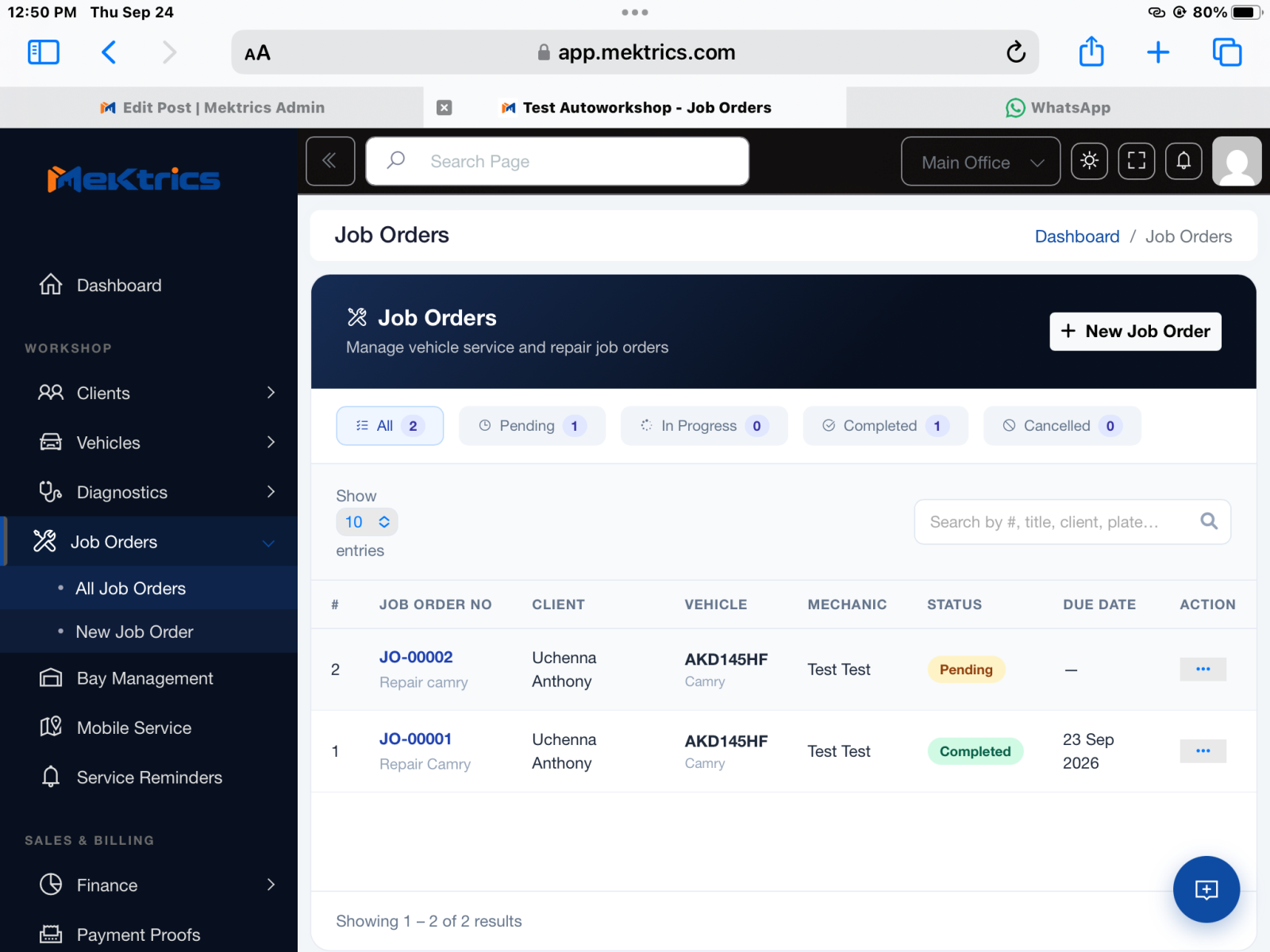
A mechanic workshop can only manage its repair jobs as well as it manages the information behind those jobs.
When a vehicle enters the workshop, there are several things that need to be recorded:
What the customer reported
Which vehicle is being repaired
What the technician discovered
Which work needs to be done
Which parts are required
How much labour will cost
Who is responsible for the job
What the customer approved
What was eventually repaired
How much the customer paid
For many auto repair workshops, all of this information starts with a job card.
Traditionally, job cards have been handwritten on paper. But as workshops become busier and more customers expect faster, more professional service, digital job cards are becoming an increasingly useful alternative.
So which is better: paper job cards or digital job cards?
The answer depends on how your workshop operates, but for workshops that want better visibility, organization and scalability, digital job cards offer significant advantages.
What Is a Job Card?
A job card is a record of the work requested, diagnosed and performed on a vehicle.
It provides a connection between the customer, vehicle and repair work.
A typical auto repair job card may contain:
Customer information
Vehicle information
Customer complaint
Inspection findings
Diagnosis
Recommended repairs
Parts required
Labour
Assigned technician
Job status
Notes
Estimated cost
Final repair information
A job card can therefore become the central record of a repair from vehicle check-in through completion.
What Is a Paper Job Card?
A paper job card is a physical form completed by hand when a vehicle enters a workshop.
The workshop may keep the completed card in a folder, cabinet or storage room.
Paper job cards have been used by mechanics for decades because they are simple, inexpensive and require no technology.
For a very small workshop with only a few jobs at a time, paper may appear sufficient.
The problems often become more obvious as the business grows.
What Is a Digital Job Card?
A digital job card is an electronic version of the repair record stored inside workshop management software.
Instead of writing information on paper, the workshop records it digitally.
Depending on the software, a digital job card can connect:
Customer → Vehicle → Inspection → Diagnosis → Technician → Parts → Labour → Invoice → Payment
This creates a connected record of the repair rather than a standalone sheet of paper.
Paper vs Digital Job CardsLet's compare the two approaches across the areas that matter most to a workshop.
AreaPaper Job CardDigital Job CardCreating a jobHandwrittenCreated digitallyFinding old jobsSearch through filesSearch electronicallyVehicle historyRequires physical recordsAvailable from digital historyTechnician assignmentManualCan be assigned in the systemParts trackingManualCan be connected to the jobLabour trackingManualCan be recorded digitallyUpdatesRequires rewriting or adding notesCan be updatedStoragePhysical spaceDigital storageRisk of physical damageHighMuch lowerReportingManualCan be generated from stored dataMultiple branchesDifficult to coordinateCan be centrally managedCustomer communicationOften separateCan be connected to the repair recordScalabilityLimitedEasier to scaleThe difference becomes increasingly important as the workshop handles more vehicles and more technicians.
1. Digital Job Cards Are Easier to FindImagine a customer returns six months after a repair.
They ask:
"What did you do to this vehicle last time?"
With paper records, someone may need to search through folders or cabinets.
If the workshop handles hundreds or thousands of vehicles, finding the right record can take considerable time.
With digital job cards, the workshop can search for the relevant customer or vehicle and access previous repair information much faster.
This is one of the simplest but most important benefits of digitizing workshop records.
2. Digital Job Cards Create Better Vehicle HistoryA vehicle often comes back to the same workshop multiple times.
Each visit adds another piece of information.
A digital system can connect these visits to the same vehicle record.
Over time, the workshop can build a useful service history showing:
Previous repairs
Previous inspections
Parts replaced
Services performed
Technician notes
Previous invoices
Customer interactions
This can help technicians and service advisors understand the vehicle before beginning new work.
It also gives the customer a more professional experience.
3. Paper Records Can Be Lost or DamagedPaper is physical.
It can be:
Misplaced
Torn
Damaged by water
Stained with oil
Filed incorrectly
Removed accidentally
Difficult to read
A workshop that depends heavily on paper records therefore has to maintain a reliable filing system.
Digital records remove many of these physical-storage problems.
That does not mean digital systems have no risks. Workshops should still choose reputable software and understand how their data is stored and protected.
4. Digital Job Cards Make Job Status Easier to TrackA busy workshop may have vehicles at different stages.
For example:
Waiting for inspection
Under diagnosis
Waiting for customer approval
Waiting for parts
Under repair
Ready for inspection
Ready for collection
With paper cards, staff may need to physically check vehicles or ask technicians for updates.
A digital workshop-management system can provide a clearer overview of job statuses.
This allows the workshop manager to identify bottlenecks more easily.
For example, if several vehicles are waiting for parts, the problem becomes visible.
5. Digital Job Cards Can Connect Parts to Repair JobsSuppose a workshop purchases brake pads.
Those brake pads eventually get used on three different vehicles.
With a paper-based process, tracking exactly where each part went can become difficult.
A digital job card can connect the part to the relevant repair job.
This creates a clearer relationship between:
Part → Repair Job → Vehicle → Customer
That information can also contribute to better inventory and profitability tracking.
6. Digital Job Cards Make Labour Tracking EasierLabour is another important component of every repair.
A workshop needs to understand not only what parts were used but also what work was performed.
Digital systems can record:
Technician
Labour item
Labour charge
Job duration
Work performed
Job status
This can help workshop managers understand how labour contributes to each repair.
7. Digital Job Cards Reduce Repetitive Data EntryWith paper, the same information may have to be copied several times.
For example:
Customer information may appear on the job card.
Then it may be written again on an invoice.
Vehicle information may be copied onto another document.
Parts may be recorded separately.
Payment may be recorded somewhere else.
A connected digital system can reduce this duplication.
Information entered once can potentially be reused across other parts of the workflow.
This saves administrative time and reduces the risk of inconsistent records.
8. Digital Job Cards Make Customer Communication EasierCustomers want to know what is happening with their vehicles.
They may ask:
Has the vehicle been inspected?
What is wrong with it?
How much will the repair cost?
Which parts are required?
Has the repair started?
Is the vehicle ready?
When the job information is properly recorded, staff can answer these questions without relying entirely on memory or searching through conversations.
The result can be faster and more consistent communication.
9. Digital Job Cards Make Reporting PossibleOne of the biggest limitations of paper records is that the information is difficult to analyze.
Imagine a workshop owner wants to know:
How many vehicles did we repair this month?
Which services are most common?
Which technicians handled the most jobs?
How much revenue came from repairs?
How much was spent on parts?
How many jobs are still open?
Which customers have returned?
Which vehicles have been serviced recently?
Paper job cards contain information, but turning that information into useful reports requires manual work.
Digital records can make reporting significantly easier.
10. Digital Job Cards Are Better for Growing WorkshopsPaper can work for a very small operation.
But consider a workshop with:
10 technicians
Multiple service bays
Hundreds of customers
Hundreds of vehicles
Several repair jobs every day
A growing parts inventory
Managing all that information on paper becomes increasingly difficult.
Digital job cards allow the workshop to create a more structured operating system.
This becomes even more important when a business opens additional branches.
Is There Still a Place for Paper Job Cards?Yes.
Paper job cards are not inherently bad.
They can be appropriate for workshops that:
Handle very few vehicles
Have simple workflows
Do not need detailed reporting
Have limited digital infrastructure
Are still experimenting with their processes
The problem occurs when the workshop's operational complexity grows beyond what paper can comfortably support.
The question should therefore not be:
"Is paper bad?"
A better question is:
"Can our current system give us the visibility and control we need?"
If the answer is no, it may be time to consider digital job cards.
What Should a Good Digital Job Card Contain?Before choosing job-card software, make sure it can capture the information your workshop actually needs.
A useful digital job card may include:
Customer details
Name
Phone number
Contact information
Vehicle details
Make
Model
Registration number
Mileage
Vehicle identification information
Customer complaint
What did the customer report?
Inspection
What did the technician find?
Diagnosis
What is causing the problem?
Recommended work
What needs to be repaired or replaced?
Parts
Which parts are required or used?
Labour
What work will the technician perform?
Technician
Who is responsible for the repair?
Approval
What work has the customer approved?
Status
Where is the repair in the workflow?
Final outcome
What was eventually repaired?
Billing
What did the customer ultimately pay?
The more connected these records are, the more useful the job card becomes.
How to Move From Paper Job Cards to Digital Job CardsA workshop does not need to transform everything in one day.
A gradual transition can work well.
Step 1: Document your current process
Write down what happens from the moment a vehicle arrives until it leaves.
Identify where information is currently recorded.
Step 2: Choose the most important records
Start with:
Customer records
Vehicle records
Job cards
Estimates
Invoices
These usually form the foundation of the repair workflow.
Step 3: Train your team
Technicians and service staff need to understand how and when to update job information.
The system works only when the team actually uses it.
Step 4: Stop creating parallel records
If your workshop decides that the digital job card is the official record, avoid continuing to maintain separate unofficial records everywhere.
Otherwise, the same problem simply moves from paper to software plus paper.
Step 5: Review the process
After a few weeks, ask:
Are jobs easier to find?
Are technicians receiving clearer instructions?
Are customers getting faster updates?
Can we find vehicle history more easily?
Are parts easier to track?
Are invoices easier to prepare?
Do managers have better visibility?
The purpose of digitization is improvement, not simply replacing handwriting with typing.
How Mektrics Handles Digital Workshop Job ManagementMektrics is designed to connect the different stages of a repair workflow rather than treating the job card as an isolated document.
A workshop can organize information around customers and their vehicles, create and manage job orders, record inspections and diagnostics, track parts and labour, manage technicians, generate estimates and invoices, and keep information available throughout the repair process.
This creates a connected workflow:
Customer → Vehicle → Job → Inspection → Diagnosis → Technician → Parts & Labour → Invoice → Payment → Service History
Instead of having one paper document that sits inside a folder, the repair record becomes part of the workshop's wider digital system.
For a growing workshop, that distinction matters.
The objective is not simply to have a digital job card.
The objective is to have a digital workshop workflow.
Digital Job Cards: The Bottom LinePaper job cards are simple, familiar and inexpensive.
But as an auto repair workshop becomes busier, paper records can make it harder to search information, track jobs, understand vehicle history, manage parts and analyze workshop performance.
Digital job cards provide a more connected approach.
They can help workshops:
Organize repair information
Track vehicles
Assign technicians
Record inspections
Track parts and labour
Manage job status
Create invoices
Maintain vehicle history
Improve customer communication
Generate useful business information
For a small workshop with very few jobs, paper may still be sufficient.
For a workshop that wants to grow, improve accountability and gain better visibility into its operations, digital job cards are worth considering.
And the biggest advantage is not the job card itself.
It is what happens when the job card becomes connected to the rest of the workshop.
Customer records. Vehicles. Inspections. Technicians. Parts. Labour. Invoices. Payments. Service history.
That is when a job card becomes part of a proper workshop management system.
Ready to move beyond paper?
Mektrics helps auto repair businesses manage their customers, vehicles, repair jobs, technicians, parts, invoices and other workshop operations in one system.
Explore Mektrics and see how digital workshop management can work for your business.

0 Comments