
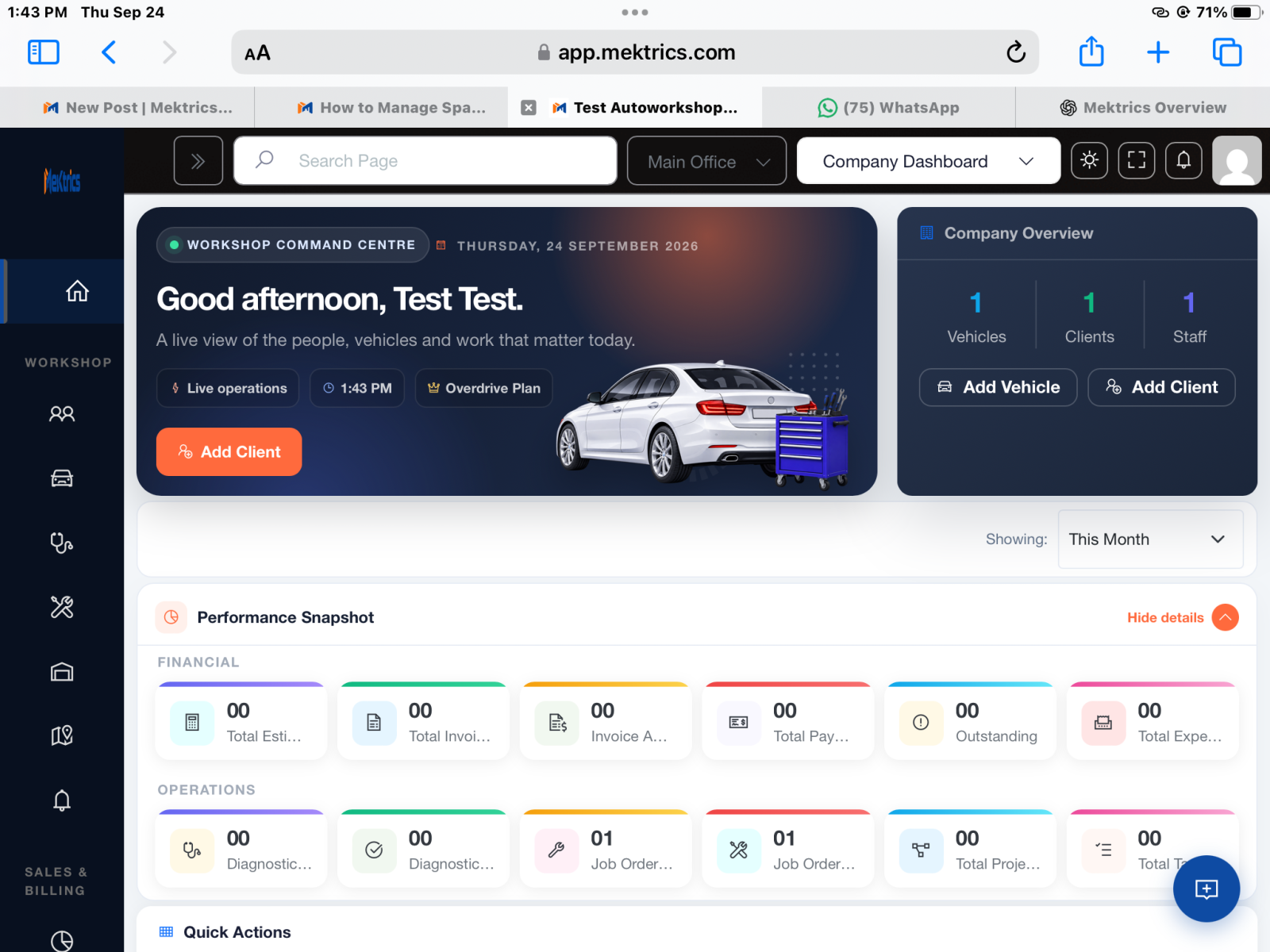
A workshop owner also needs to know:
How many vehicles are coming in?
How much revenue is being generated?
How much does the average customer spend?
How much work are customers approving?
Which technicians are productive?
How much are parts costing?
Which jobs are profitable?
How much money is still outstanding?
Are customers returning?
Is the workshop actually becoming more profitable?
These questions are answered by Key Performance Indicators (KPIs).
KPIs turn the information generated by your daily workshop operations into numbers you can use to understand the business.
Modern workshop-management platforms commonly track measures such as average repair order, car count, close ratio, labour performance, parts margins and profitability. (Mektric.com)
For a Nigerian mechanic workshop, you don't need dozens of complicated metrics.
You need a manageable set of numbers that tell you what is happening and where attention may be required.
Here are 10 useful auto repair shop KPIs to start tracking.
What Are KPIs for an Auto Repair Workshop?
A Key Performance Indicator is a measurable number that helps you understand how a particular part of your business is performing.
For example:
Number of repair jobs this month tells you about workshop volume.
Average repair order tells you the average value of those jobs.
Parts margin tells you how much gross margin you're generating from parts.
Technician productivity helps you understand how effectively technician time is being used.
The important thing is not simply collecting numbers.
The goal is to use the numbers to ask better business questions.
1. Repair Order CountWhat it measures
Your repair order count tells you how many repair jobs your workshop processed during a particular period.
For example:
Monday: 8 repair orders
Tuesday: 11
Wednesday: 9
Thursday: 13
Friday: 15
Weekly total: 56 repair orders
Formula
Repair Order Count = Number of completed/posted repair orders during the period
Why it matters
Repair order count gives you a basic picture of workshop demand.
If your workshop normally handles 100 jobs per month but suddenly drops to 65, something may have changed.
Possible causes could include:
Fewer customers
Seasonal demand
Marketing changes
Customer service problems
Capacity constraints
Technician shortages
Operational bottlenecks
But don't look at repair-order count alone.
A workshop can have many jobs and still struggle financially if those jobs are poorly priced or have weak margins.
That's why this KPI should be combined with the others below.
2. Average Repair OrderAverage Repair Order (ARO) measures the average amount charged per repair order.
Formula
ARO = Total repair revenue ÷ Number of repair orders
For example:
If a workshop generates ₦5,000,000 from 100 repair orders:
₦5,000,000 ÷ 100 = ₦50,000 ARO
That means the average repair order generated ₦50,000.
ARO is widely used in automotive repair reporting; current shop-management platforms define it essentially as total repair revenue divided by repair orders.
Why it matters
ARO helps you understand the average value of the work you're completing.
You might discover:
Month 1: ₦42,000
Month 2: ₦46,000
Month 3: ₦51,000
That trend gives you useful information when viewed alongside car count, margins and customer approvals.
A falling ARO could reflect a change in the type of work coming into the workshop, pricing changes or fewer recommended repairs being approved.
It shouldn't automatically be interpreted as a problem.
3. Total Workshop RevenueRevenue is the total amount generated from your workshop's sales before subtracting your costs.
Depending on your business model, this may include:
Labour
Spare parts
Diagnostics
Maintenance services
Tyres
Batteries
Other workshop services
Formula
Total Revenue = Total sales during the period
Track it daily, weekly and monthly.
Why it matters
Revenue tells you how much business the workshop is generating.
But remember:
Revenue is not profit.
A workshop could generate ₦10 million in sales while having very high expenses.
That's why revenue should always be examined alongside parts costs, labour costs and other operating expenses.
4. Gross ProfitThis is one of the most important financial KPIs.
Gross profit shows what remains after the direct costs associated with the work have been deducted.
A simplified formula is:
Gross Profit = Revenue − Direct Costs
Direct costs might include:
Parts
Technician labour
Certain subcontracted services
For example:
Revenue: ₦1,000,000
Direct costs: ₦650,000
Gross profit: ₦350,000
Why it matters
A workshop shouldn't judge its performance purely by sales.
Imagine two workshops:
Workshop A
Revenue: ₦8mGross profit: ₦2.8mWorkshop B
Revenue: ₦10mGross profit: ₦2.2mThe second workshop generated more revenue, but its direct costs consumed more of that revenue.
This is why understanding profit matters.
5. Parts Gross MarginParts can represent a significant part of a repair order.
Parts gross margin helps you understand how much gross margin you're generating from parts sold.
Formula
Parts Gross Margin = (Parts Sales − Parts Cost) ÷ Parts Sales × 100
For example:
Parts sold: ₦500,000
Parts cost: ₦350,000
Gross profit: ₦150,000
Gross margin:
₦150,000 ÷ ₦500,000 × 100 = 30%
Why it matters
If your workshop sells a lot of parts but makes very little margin on them, high sales don't necessarily translate into strong profitability.
Tracking this KPI can help you examine:
Supplier prices
Parts pricing
Discounts
Markups
Incorrect cost records
Parts losses
Current workshop reporting systems commonly separate parts sales and parts margin because this gives owners more visibility into where workshop profitability comes from.
6. Technician ProductivityYour technicians are central to your workshop's ability to generate revenue.
Technician productivity helps you understand how effectively available technician time is being converted into billable work.
One simple approach is:
Technician Productivity = Billed Hours ÷ Available or Worked Hours × 100
For example:
A technician works 40 hours.
The workshop bills 32 labour hours.
32 ÷ 40 × 100 = 80%
That gives you an 80% productivity figure under this particular definition.
Different workshop-management systems calculate technician productivity or efficiency differently, so your team should agree on one definition and use it consistently. Current platforms, for example, distinguish between tracked hours, billed hours and different efficiency calculations.
Why it matters
It can help you identify:
Underused capacity
Workflow bottlenecks
Training needs
Scheduling problems
Jobs taking longer than expected
Technicians who need additional support
The number should be used as a management tool, not as a standalone judgment about a technician.
7. Estimate Close RateNot every customer who receives an estimate approves all the recommended work.
Your close rate measures how much of the work presented to customers gets approved.
A simplified formula is:
Close Rate = Approved Work ÷ Presented Work × 100
For example:
Work presented: ₦4,000,000
Work approved: ₦3,000,000
Close rate:
₦3,000,000 ÷ ₦4,000,000 × 100 = 75%
Why it matters
A workshop can have plenty of customers but still leave significant revenue on the table if recommended work is regularly declined.
A low close rate doesn't automatically tell you why customers are declining work.
Possible explanations could include:
Price
Poor explanation
Lack of trust
Timing
Customer budget
Customer choosing another workshop
Non-urgent repairs being postponed
The KPI tells you where to investigate.
8. Jobs Waiting for PartsThis is a particularly useful operational KPI.
Track how many active repair jobs are currently waiting for parts.
For example:
18 active vehicles
5 waiting for parts
That means more than a quarter of the active workload may currently be blocked by parts availability.
Why it matters
A vehicle occupying workshop capacity while waiting for a part can affect:
Bay availability
Technician scheduling
Customer satisfaction
Job completion time
Cash flow
This KPI also connects directly to the spare-parts inventory article we published previously.
Good inventory management should help reduce unnecessary parts-related delays.
9. Outstanding Customer BalancesRevenue recorded on paper isn't necessarily money in the bank.
Track how much customers currently owe the workshop.
For example:
Total invoiced: ₦7,500,000
Payments received: ₦6,800,000
Outstanding: ₦700,000
Why it matters
If outstanding balances continue increasing, your workshop may appear busy while cash available to operate the business becomes tighter.
Track:
Current outstanding balances
Age of unpaid invoices
Customers with repeated outstanding balances
Amount overdue
Having clear invoices, payment records and customer histories makes this easier to manage.
10. Customer Return RateA workshop isn't only trying to repair vehicles once.
A healthy customer relationship can result in future:
Servicing
Repairs
Maintenance
Inspections
Referrals
Customer return rate helps you understand how many customers come back.
A simple measurement could be:
Returning Customers ÷ Total Customers × 100
For example:
300 customers visited during a period.
120 were returning customers.
120 ÷ 300 × 100 = 40%
The exact measurement should be defined consistently—for example, whether you're measuring customers who returned within 6 or 12 months.
Why it matters
Returning customers provide useful information about customer retention.
If the percentage changes significantly, investigate what may have changed in:
Customer service
Pricing
Repair quality
Follow-up
Convenience
Communication
Competition
A dashboard full of numbers isn't automatically useful.
The important question is:
What decision will this number help me make?
For example:
ARO is falling
Ask:
Are customers approving less work?
Parts margin is falling
Ask:
Have supplier costs increased or are we discounting too much?
Technician productivity is falling
Ask:
Are technicians waiting for parts, vehicles, approvals or instructions?
Outstanding balances are increasing
Ask:
Are we allowing too much unpaid work?
Jobs waiting for parts are increasing
Ask:
Are we purchasing frequently used parts early enough?
Customer return rate is falling
Ask:
Has something changed in the customer experience or follow-up process?
That's how KPIs become useful.
How Often Should a Workshop Review Its KPIs?You don't need to stare at every number every hour.
A simple schedule can work.
Daily
Review:
Jobs completed
Revenue
Payments
Active jobs
Jobs waiting for parts
Outstanding balances
Weekly
Review:
Repair order count
ARO
Technician productivity
Estimate close rate
Parts usage
Open jobs
Monthly
Review:
Revenue
Gross profit
Parts margin
Technician performance trends
Customer return rate
Outstanding balances
Overall business performance
The important thing is consistency.
A number becomes much more useful when you can compare it over time.
How Digital Workshop Management Makes KPI Tracking EasierThe difficult part of KPI tracking isn't necessarily the mathematics.
The difficult part is collecting reliable data.
Imagine trying to calculate your ARO from:
Paper job cards
A notebook
WhatsApp messages
Separate invoices
Technician notes
Supplier receipts
A spreadsheet
The process becomes slow and errors can creep in.
A connected workshop-management system can bring many of these records together.
For example:
Customer
↓
Vehicle
↓
Job Card
↓
Inspection
↓
Parts + Labour
↓
Invoice
↓
Payment
↓
Workshop Reports
This creates a much stronger foundation for measuring performance.
Modern repair-shop platforms increasingly emphasize real-time reporting because metrics such as ARO, car count, close rate and technician efficiency are most useful when they are connected to the underlying repair workflow. (tekmetric.com)
How Mektrics Can Help Workshop Owners Understand Their NumbersMektrics is designed to bring workshop operations into one connected system.
Instead of keeping customer information in one place, job cards somewhere else, inventory records in another system and payment information somewhere else, the workshop can organize its operations around the repair process.
That creates the foundation for understanding questions such as:
How many jobs are we handling?
Which jobs are still open?
What work has been completed?
Which technicians are handling jobs?
What parts are being used?
How much are customers being charged?
What payments have been recorded?
Which customers and vehicles have previous service history?
The more consistently your workshop records its operations, the more useful your business data becomes.
And that is the real purpose of workshop KPIs.
Not more numbers. Better decisions.
A Simple KPI Dashboard for a Nigerian Mechanic WorkshopIf you're just starting, don't try to track everything.
Start with these five:
1. Jobs Completed
How many repair jobs did we complete?
2. Average Repair Order
How much does the average job generate?
3. Revenue
How much did we sell?
4. Gross Profit
How much remained after direct costs?
5. Outstanding Balances
How much money is still owed?
Once these are working reliably, add:
Technician productivity
Parts margin
Close rate
Jobs waiting for parts
Customer return rate
This gives you a progressively stronger picture of the business.
Final ThoughtsRunning an auto repair workshop by intuition can work when the business is very small.
But as the workshop grows, intuition alone becomes harder to rely on.
You need to know what is actually happening.
How many jobs are coming in?
How much is each job worth?
How much are parts costing?
How productive is the workshop?
How much work are customers approving?
How much money is still outstanding?
Are customers coming back?
These are the questions that KPIs help answer.
You don't need 50 dashboards.
Start with a handful of numbers that directly connect to the way your workshop operates, review them consistently, and use changes in those numbers to investigate what is happening.
Once your workshop has reliable digital records for customers, vehicles, job cards, parts, labour, invoices and payments, measuring performance becomes much easier.
A workshop that records its work can understand its numbers.
A workshop that understands its numbers can make better-informed business decisions.
And that's where workshop management software becomes more than a way to replace paperwork—it becomes a tool for understanding the business.
Ready to get better visibility into your workshop? Explore Mektrics and start managing your workshop operations in one place.
0 Comments